


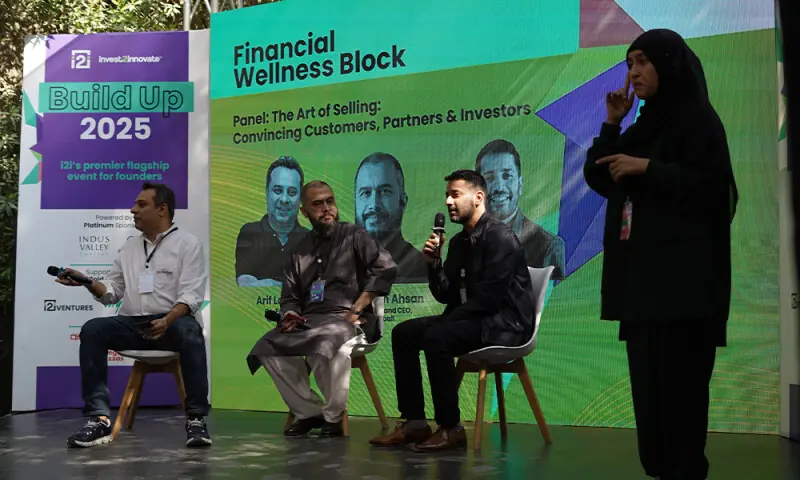
Sharing secrets behind his success story in Pakistan, the co-founder of startup Qist Bazaar, Arif Lakhani, said his company placed advertisements on big billboards along the route frequently traveled by their potential partners and investors. The approach helped in building familiarity and winning partnerships and investors.
The Buy Now Pay Later (BNPL) company ran four different advertisements in a short duration of a month on a billboard along a route frequently traveled by a key partner before meeting them. “When we went to meet them and introduced ourselves, they said they recognized us due to the billboard advertisements that cost us significantly, but it worked out actually,” Lakhani said at the Build Up 2025 conference organized by Invest2Innovate (i2i) in Karachi on Saturday.
While moderating a panel discussion titled ‘The Art of Selling: Convincing Customers, Partners & Investors’, Lakhani said they used the same approach to secure another valuable partner in the past. These efforts were part of the countless actions they took to make their startup successful.
The fintech was launched in November 2021. It offers BNPL service, offering mobile phones, home appliances and a variety of other things on installments. The startup secured $3.2 million in Series A funding round in September 2024, it was learnt.
Meanwhiel Nutrilov co-founder Uzair Tahir said when he visited supermarkets and did not find his company products on the shelves he would go to the store-counters and ask about his products.
His wife would do the same. Not long after, the company started getting calls from stores and supermarkets inquiring about how to stock his products.
While sharing secrets behind the success of his snacks firm in Pakistan, he suggested to conference participants that startups should begin marketing products from small shops to build their brand. “If you start with marketing products on shelves of big supermarkets, they will charge you a heavy listing fee and super margins and this will get your startup closed in six months,” he said.
Omer Bin Ahsan, the founder and CEO of Haball – a business to business (B2B) supply chain payments and financing fintech – said startups should always prepare for rejection from clients yet remain consistent if they want to succeed. They must understand why they were turned down and see how they can remove those concerns.
Those who cannot face rejection cannot sell products. “We met CocaCola 48 times and eventually got them (as a client) through consistently answering each and every question raised by them,” he said.
He suggested when startups go to meet a new client, it’s good to give examples of other clients they are serving in the same sector, showing you know its ins and outs.
He talked about how Haball faced stiff competition from conventional big banks. To counter this, it did a lot of work which banks avoid to earn clients, particularly in small and medium-sized enterprises (SMEs).
“It is hard work and trust in yourself which help you win new business,“ he said.
Build Up 2025 brings startups community together
While talking to Business Recorder, i2i CEO Sarah Munir said the conference was organized to get startups connected to the community, learn from others experiences and reflect on their own.
She said there was a big community of smart people trying to build new things and trying to solve problems. “We hope that anybody who comes here is able to connect with someone else who has faced similar challenges that they are are facing today and their perspective got changed. The participants feel they are not alone but part of something bigger.”
The conference was divided into three parts; financial wellbeing, operational wellbeing, and mental and emotional wellbeing. “It is a must to get the three things lined up to be successful,“ she said.
Munir said startups are securing financing at a later stage instead from the beginning. Now they are able to find mixed funding rather than only foreign funding, as the local ecosystem is also mobilizing. “The VC [venture capital] mentality of raising early funding, burning it and growing has kind of phased out. Because markets like Pakistan don’t work like that,” Munir added.
While speaking at a panel discussion on ‘The Pressure to Raise and What Happens After’, Saleflo co-Founder Sharoon Saleem said the best money startups raise is their customers’ money that they earn through selling their products, as he was against the idea of securing debt to run businesses.
Misbah Naqvi, co-founder, i2i Ventures, who was moderating the panel agreed with Saleem that startups may remain focused on the revenue-earning model to sustain the business, but argued “when they need to grow and expand then they need external money.”
Other speakers on the panel including Myco, founder/CEO Somair Rizvi; and Sehat Kahani co-founder Sara Saeed Khurram urged participants to learn to say no to those investors who ask them to alter their business ideas for the money.
Rather, they should continue to trust in themselves and remain consistent and focused on their original ideas and the goals they have set to achieve.
They asked them to remain ambitious and do whatever they think is right for their growth without any hesitations.
