


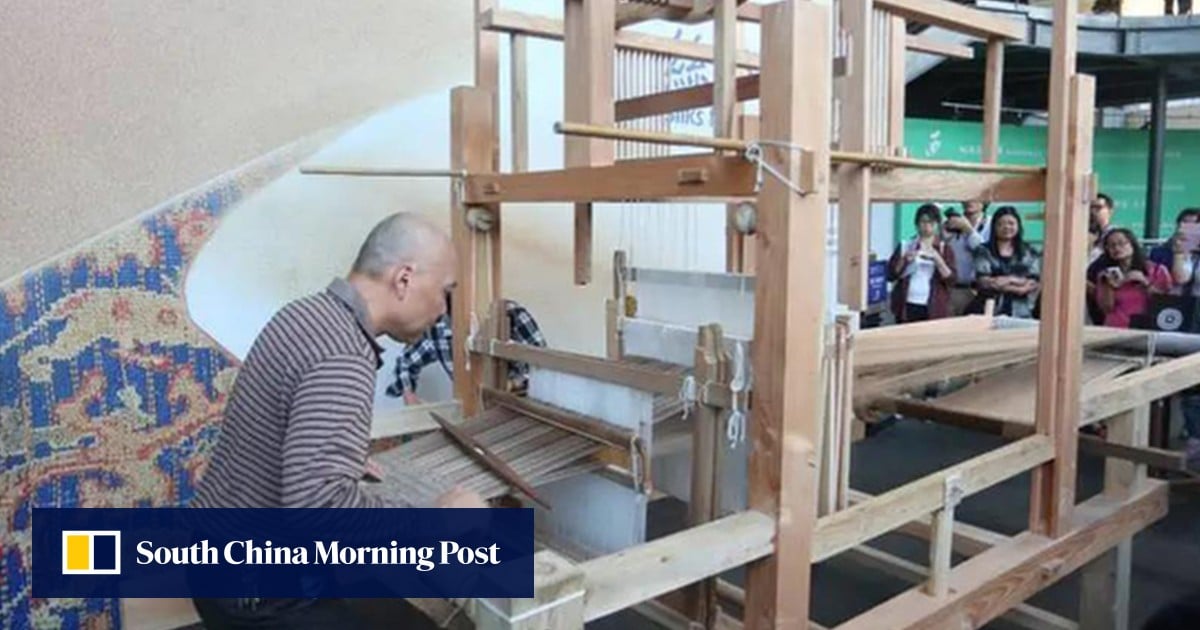
The computer, at its core, is an input-output device: it receives instructions, executes programmes, performs calculations automatically and produces results.
By this fundamental definition, China’s ancient ti hua ji, or figured loom – dating back more than two millennia to the Western Han dynasty – may well be recognised as the world’s earliest computer, according to the China Association for Science and Technology (CAST).
Unearthed in 2012 from a tomb dated around 150BC in Chengdu, this sophisticated silk-weaving machine made use of programmable computation. Its “programme” came in the form of physical pattern cards – the ancient equivalent of software – which directed the lifting of individual warp threads according to a preset design.
A raised warp thread represents 1, while a lowered one represents 0.
It is the world’s oldest known “computer hardware”, with corresponding “software” – the figure loom programme, CAST said in a video posted on its social media account on December 27.
CAST is China’s largest official scientific body. Its entry into the global debate over who invented the first computer, and the public endorsement of the Chengdu loom as proto-computing hardware, signals a growing momentum to rewrite technological history from a non-Western perspective.
