


RIO FRIO, Portugal (AP) — U.S. winemakers have something to celebrate: the corks they’re popping aren’t subject to tariffs.
Cork comes from the spongy bark of the cork oak tree, which is primarily grown and harvested in the Mediterranean basin. The framework trade agreement between the United States and the European Union singled out the material as an “unavailable natural product.” So as of Sept. 1, cork joined a handful of other items, including airplanes and generic pharmaceuticals, that are exempt from a 15% U.S. tariff on most EU products.
The cork carve-out was vital for Portugal. The European country is the world’s largest cork producer, accounting for about half of global production.
Portuguese diplomats lobbied for the exemption on both sides of the Atlantic. Patrick Spencer, the executive director of the U.S.-based Natural Cork Council, raced from Salem, Oregon, to Washington in June to explain cork’s origins to U.S. trade officials and to seek a tariff reprieve. The Wine Institute, which represents California vintners, said it also pushed for the special dispensation.
Spencer said he was thrilled when a summary of the U.S.-EU agreement released in August mentioned cork.
“It was a great day in our neighborhood,” said Spencer, a self-described “cork dork.”
More than cork
It’s unclear if cork is unique or if other natural products will be exempt from U.S. tariffs in future trade agreements. The U.S. Department of Commerce and the White House did not respond when The Associated Press asked about tariff exemptions.
It’s not even clear if the tariffs President Donald Trump put on imports from the EU’s 27 member nations and almost every country will remain. Late last month, a U.S. appeals court ruled that Trump had no right to impose his sweeping tariffs, although it left them in place while his administration appeals to the U.S. Supreme Court.
But if the tariffs stay in place, cork may signal other exemptions to come. U.S. Commerce Secretary Howard Lutnick indicated during a July interview with CNBC that natural products like mangoes or cocoa may be free from tariffs
U.S. dependence
The U.S. is the second-largest market for Portuguese cork after France. In 2023, the U.S. imported $241 million worth of cork from Portugal; just over 70% of it came in the form of stoppers for wine, spirits, olive oil, honey and other liquids, according to the Natural Cork Council, a trade group.
Cork has other applications, too. NASA and SpaceX have used it for thermal protection on rockets. Cork crumbles are also used as infill for sports fields and inserted into concrete on airport runways to help absorb the shock of plane landings.
Even though California has a similar climate to the Mediterranean, the U.S. has never developed a cork industry. There was an attempt to start one during World War II, and around 500 cork oaks from that period remain on the campus of the University of California, Davis.
But the effort evaporated when the war ended. The problem: it takes 25 years for a cork tree to produce its first bark for harvesting, and the initial yield typically isn’t high quality. After that, it takes the tree about nine years to grow new bark.
“Americans are not patient enough to wait for a tree that takes 25 years to give its first harvest,” said Antonio Amorim, the chairman and CEO of Portugal’s Corticeira Amorim, one of the world’s largest cork companies.
Cork harvesting is also an extremely specialized skill, since cutting into a tree the wrong way could kill it. Cork harvesters are the highest paid agricultural workers in Europe, Spencer said.
Harvesting by hand
Amorim, which exports cork to more than 100 countries, has more than 20 million cork trees spread over 700,000 hectares (1.7 million acres) of woodland.
On a recent day at Amorim’s Herdade de Rio Frio, a farm 40 kilometers (25 miles) southeast of Lisbon, crews zig-zagged across the thin, pale grass between scattered cork trees, kicking up dust.
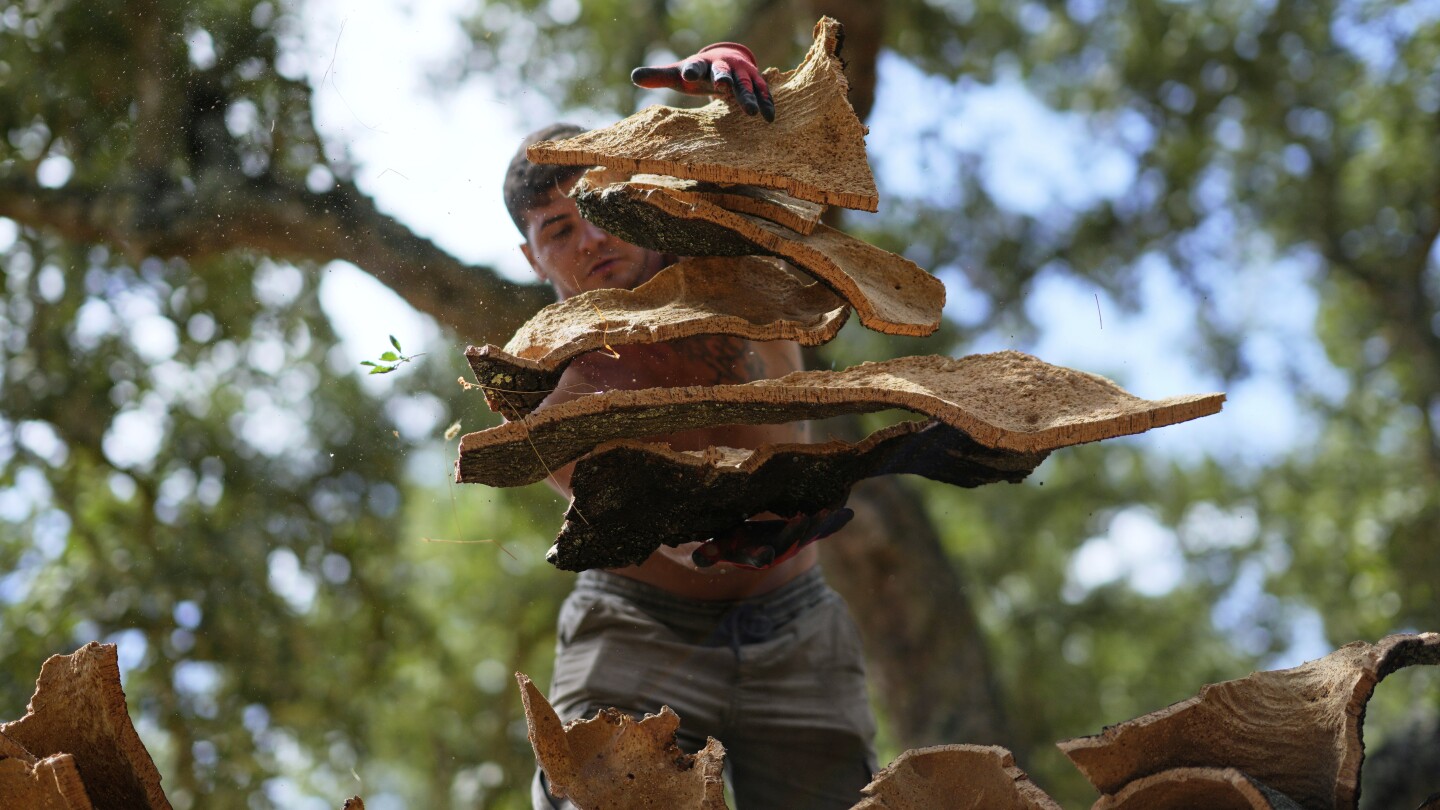
The quiet woodland echoed with the gentle thud of the workers’ axes. They gently pierced the bark, feeling for the thickness of cork that could be peeled off without harming the trunk. The Portuguese have harvested cork this way for more than 200 years.
The tree bark came off in featherweight slabs that the workers, their hands black from the oaks’ natural tannins, tossed onto a flatbed truck. It would go to factories to be cut into strips and fed into a machine that punches out stoppers.
Once the trees were bare, a woman painted a white “5” on the orange-colored trunks, signaling they were stripped in 2025. Herdade de Rio Frio’s cork oaks, which are native to Portugal and can resist frequent droughts and scorching summer temperatures, were planted more than 100 years ago.
Stick a cork in it
Cork’s sustainable harvesting process and its biodegradability are two reasons many U.S. winemakers have returned to plugging bottles with it after experimenting with closures made of aluminum, plastic and glass. In 2010, 53% of premium U.S. wines used cork stoppers; by 2022, that had risen to 64.5%, according to the Natural Cork Council.
Cork taint, which gives wine a funky taste and is caused by a fungus in natural corks, was a big problem in the 1990s, and it pushed many vintners into aluminum screw caps and other closures, said Andrew Waterhouse, a chemist and director of the Robert Mondavi Institute of Wine and Food Science at the University of California, Davis.
The cork industry has largely solved that problem, Waterhouse said. In the meantime, the wine industry came up with new technology, like screw caps that can mimic cork in the amount of oxygen they let into a bottle over time.
Many wineries, including Trump Winery in Virginia, now use both screw caps and natural corks. Waterhouse said screw caps generally make more sense for a wine like rosé, which isn’t intended to age, while cork is the standard for aging wines.
“If you say, ‘Has this wine aged properly?,’ what you mean is, ‘Was it in a glass bottle with a cork seal in a cool cellar?’ Under any other conditions, it didn’t age the same,” Waterhouse said. “We’re always trapped by history.”
___
Durbin reported from Detroit.
