
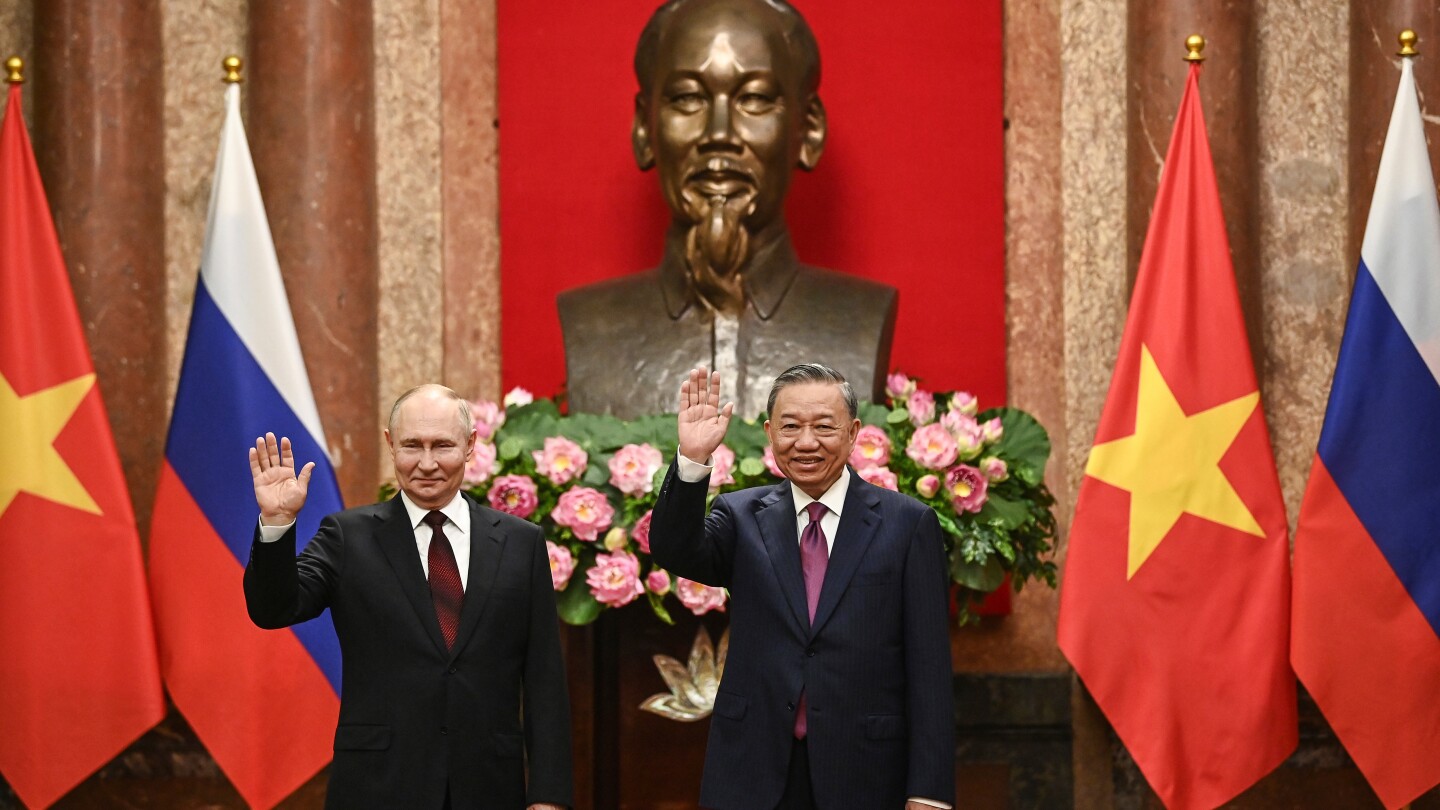
BANGKOK (AP) — Russia and Vietnam have developed a back-door method of concealing arms deal payments to avoid American and other Western sanctions, using the profits from joint oil and gas ventures to pay off defense contracts without any open transfers of cash through the global banking system, according to internal Vietnamese documents obtained by The Associated Press.
Under the system, Vietnam has purchased Russian military equipment including fighter jets, tanks and ships on credit from Moscow, then pay that credit back from its share of profits from a joint Vietnam-Russia oil company operating in Siberia. Such transactions are irregular in international financial markets and in this case are designed to keep cash quietly flowing even if sanctions aimed at ending Russia’s war on Ukraine are strengthened, the documents make clear.
The revelation comes at a precarious time when the U.S. is trying to strengthen ties with Vietnam as a bulwark against growing Chinese assertiveness in Southeast Asia, and has ongoing trade negotiations after the White House imposed 20% tariffs on Hanoi, while at the same time President Donald Trump is threatening even more stringent sanctions on Moscow.
The European Union has also added a raft of new sanctions to pressure Russian President Vladimir Putin to end the war, and Trump recently issued an executive order doubling tariffs on India to 50% to pressure New Delhi to stop buying Russian oil and military equipment, which he said was helping enable the war against Ukraine.
The Trump Organization, the president’s family business, also broke ground earlier this year on a $1.5 billion luxury golf complex outside the capital, Hanoi, after Vietnam fast-tracked approval. The president’s sons run the organization, but financial disclosures in June indicated that Trump himself benefits from many of its activities.
News that the unorthodox arrangement was in the works leaked in 2023. But rather than shutting it down, an internal document from last year reveals that Russia and Vietnam finalized and implemented it, while also making agreements to ensure it would produce sufficient funds for future military purchases.
The Vietnamese government document that was leaked in 2023 and the newer government document from last year were provided to The Associated Press by an official who said that he was part of a faction opposed to closer ties to Russia at the risk of jeopardizing the growing relationship with Washington. He provided the documents on condition of anonymity to protect himself from possible reprisals from Vietnam’s authoritarian government.
The U.S. State Department refused to comment specifically on the documents or the payment plan designed to skirt American sanctions, referring comments to the Vietnamese government. It reiterated broadly, however, that “our sanctions remain in place.”
“Those engaging in certain transactions or activities with sanctioned entities and individuals may expose themselves to sanctions risk or be subject to an enforcement action,” the State Department said in an email to the AP this week.
Vietnam’s Ministry of Industry, the Vietnam Oil and Gas Group, known as Petrovietnam or PVN, and the Foreign Ministry did not respond to multiple emails seeking comment on the payment scheme. Russia’s Finance Ministry, which conducted the negotiations for Moscow, also did not respond.
“It’s not your typical flexible financing. It’s not your typical offset or counter-trade provisions,” said Evan Laksmana, who leads the Southeast Asian Security and Defense research program for the International Institute for Strategic Studies think tank.
“It is,” Laksmana said, “next-level stuff.”
How the arrangement works
The mechanism involves using Vietnam’s profits from a joint Vietnam-Russia oil venture in Siberia, Rusvietpetro, to repay loans for military purchases while avoiding transactions through the global SWIFT network system, which powers most international financial transfers and is overseen by the United States and other western nations. In effect, it’s a series of transactions that skip carefully laid global financial pathways, keeping transactions secret.
Final details of the agreement were laid out last summer in the 2024 memo obtained by the AP, from PVN to Vietnam’s Ministry of Industry and Trade ahead of a visit to Hanoi by Russian President Vladimir Putin.
The plan outlined involves:
—First, Vietnamese profits from the Rusvietpetro joint venture in Siberia are sent to Moscow to pay back credit extended for military purchases;
—then, Vietnam’s profits exceeding the loan repayments are transferred to Russian state-owned oil and gas company Zarubezhneft in Russia;
—finally, in Vietnam, Zarubezhneft uses its joint venture company there to transfer an equal amount of money to PVN, effectively avoiding any international financial transfers.
“In the context of the U.S. and Western countries imposing sanctions on Russia in general and removing Russia from SWIFT in particular, this payment method is considered relatively confidential and appropriate because money only circulates within the territory of Vietnam and Russia and Vietnam does not have to worry about the risks of being affected by the U.S. embargo,” PVN’s general director, Le Ngoc Son, writes in the June 11, 2024, document.
Laksmana said he did not have previous knowledge of the plan, but that it fit with Moscow’s approach toward arms deals in the region. In 2017, for example, Russia agreed to provide 11 Sukhoi Su-35 fighter jets to Indonesia in exchange for palm oil, coffee and other goods.
“Russia was for a long time in Southeast Asia considered to be among the most flexible in terms of its payment mechanisms,” he said.
Two Western diplomats posted to Hanoi said they had long suspected Vietnam and Russia had a backdoor agreement to pay for large military contracts, though the specifics of the agreement in the documents obtained by the AP were new to them. They both spoke on condition of anonymity due to the political sensitivities of the issue.
Why is the mechanism necessary?
Zarubezhneft does not currently face sanctions imposed following Russia’s attacks on Ukraine, though its CEO, Sergei Kudryashov, was named in a raft of sweeping sanctions on the Russian energy sector announced in January, ten days before Trump was inaugurated.
Zarubezhneft board chairman Evgeniy Murov, a former KGB officer, was also sanctioned by the U.S. in 2014 when he headed the Federal Protective Service, responsible for the safety of Russian President Vladimir Putin and other high-ranking officials.
As individuals on the Office of Foreign Assets Control’s SDN list, any assets they have in the U.S. would be blocked and Americans would be prohibited from having direct dealings with them.
The mechanism outlined in the documents obtained by the AP seems intended to avoid the possibility of future sanctions, and the threat of secondary sanctions that could be imposed on those who facilitate the activities of entities under primary sanctions.
“If you want to insulate yourself from any kind of risk, you then basically avoid cross-border transactions and create these kind of offsetting payment schemes,” said. Ben Hilgenstock, a senior economist at the Kyiv School of Economics who is an expert on Russian sanctions and analyzed the Vietnamese documents for the AP.
Following a wave of fresh Russian attacks on Ukraine this month, Trump has said he is ready to move to a second phase of sanctions on Moscow or countries that buy its oil. Last week, EU and American officials met in Washington to discuss details. Last Friday, Britain announced a new set of sanctions targeting Russia’s oil revenues and military supplies, including banning 70 ships from a “shadow fleet” it said is being used to transport Russian oil to circumvent international sanctions.
The main threat of secondary sanctions comes from the Countering America’s Adversaries Through Sanctions Act, or CAATSA, measures adopted during Trump’s first term, which make it possible to impose sanctions on countries or people with commercial dealings with Russia’s military-industrial complex.
The threat is particularly powerful due to its vagueness, Hilgenstock said, which prompts companies and countries to exercise an overabundance of caution.
”Everyone else is left figuring out where exactly the red line is and how to toe it, and how not to cross it,” he said. “And the result is compliance, or more often overcompliance.”
Vietnam’s strategic strength is on the rise
Vietnam has one of the most capable militaries in Southeast Asia and has been strengthening its naval and air power, largely geared toward a possible threat from China. China today is Vietnam’s largest trade partner, but confrontations between the two countries over South China Sea territorial claims are growing.
The United States, meantime, is Vietnam’s largest export market. And since Washington lifted its arms embargo on Vietnam in 2016, it has become increasingly important in supplying defense goods. The U.S. government also sees Vietnam as an important strategic partner as it seeks to counter China.
A decades-long defense relationship with Russia means that Vietnam will be dependent upon Russia for spare parts and other material for years to come, however, and recent contracts suggest Hanoi is not backing away from Moscow even as ties with the U.S. grow closer.
In 2011, Russia extended Vietnam $2 billion in credit for a deal that included two frigates for its navy and 64 T90S tanks. Another $8 billion in credit was given for a 2023 defense deal involving SU-30 fighter jets and two more frigates; none of which Russia has delivered yet.
The official who provided the two internal Vietnamese-language documents detailing the repayment arrangement provided access to other internal government information that was verified by the AP through other sources, demonstrating his role in multiple high-level activities within Vietnam’s political and governmental hierarchy.
The earlier document outlining the early stages of planning, from March 2023, was reported on by The New York Times later that same year.
In the earlier document, Vietnam’s Finance Ministry warns that arms deals with Russia could lead to American sanctions “because the U.S. has continuously pressured Vietnam to switch to buying U.S. weapons, threatening to sanction Vietnam under CAATSA if Vietnam continues to buy Russian weapons.”
But at the same time, it suggests the United States may be persuaded to hold off on imposing sanctions on Vietnam because, among other things, “the U.S. values Vietnam’s role in implementing the Indo-Pacific strategy” meant to counter China’s growing assertiveness.
When the 2023 document leaked, Vietnam’s ruling Communist Party dismissed it as a Russian fake meant to damage Hanoi’s relations with Washington, as the countries prepared to elevate their relations to a “Comprehensive Strategic Partnership,” Vietnam’s highest level of diplomatic ties, an official privy to the internal communications told the AP on condition of anonymity to avoid possible reprisals.
But there was no sign of any rift when then President Joe Biden arrived in September 2023 to finalize the partnership.
Analysis of the documents backs up their authenticity
Both documents appear genuine, from the embedded metadata, format, unique classification codes and other details, said Ben Swanton, co-director of The 88 Project, an NGO focused on human rights abuses in Vietnam that frequently deals with government documents.
Vietnam also has a track record of deliberately misleading Washington, and when it has been called out on it, so far there has been no action taken, he said.
For example, last year the 88 Project provided the U.S. State Department with internal Vietnamese documents detailing how Hanoi was misinforming Washington about its efforts to address human trafficking concerns, but the State Department upgraded Vietnam in its annual trafficking report anyhow, Swanton said.
“Vietnam has learned that Washington will give it a free pass basically,” he said.
The State Department defended the decision to upgrade Vietnam, saying that “the government demonstrated overall increasing efforts” to eliminate trafficking, though conceded it still “did not fully meet the minimum standards.”
Plans spelled out in the documents obtained by AP have also now come to fruition. During Putin’s June 2024 visit to Hanoi, Zarubezhneft received a license to develop the “Block 11-2” gas field on Vietnam’s continental shelf, the same area mentioned in the 2024 PVN memo. An internal PVN document from this April, obtained by the AP from a different source, said Zarubezhneft had begun 3D mapping of the block.
And during a May visit to Moscow, a delegation led by To Lam, Vietnam’s top official, signed a number of oil and gas exploration-related deals and a “Strategic Partnership Plan” for defense and other cooperation covering 2026 to 2030, according to a joint statement from both sides.
It now remains to be seen how the mechanism will be used as sanctions pressure grows from the EU and the U.S., said Huong Le-Thu, deputy director of the International Crisis Group think tank’s Asia Program.
“Vietnam needs to navigate in this less conducive diplomatic environment where being too close to Russia will not be well received in European capitals,” Le-Thu said, noting that Hanoi is also now faced with an American administration far more transactional in approach.
“It’s fair to assume they are not going to be as generous as the previous administrations,” she said, “even with a recognition of Vietnam’s strategic value.”
___
Daria Litvinova in Tallinn, Estonia contributed to this story.
