


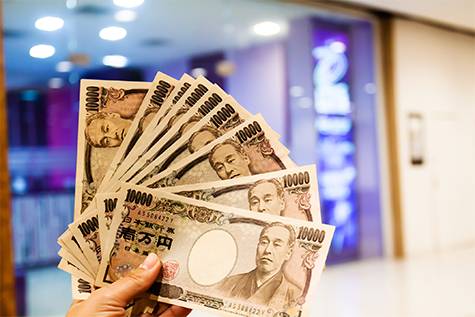
The Japanese yen rose on Monday, supported by comments from Bank of Japan Governor Kazuo Ueda, who hinted at a possible rate hike in December, while the dollar came under pressure as investors intensified their bets on a Federal Reserve cut this month.
Ueda said on Monday that the central bank will examine the “pros and cons” of raising interest rates at its upcoming December meeting, marking the strongest signal so far that a hike is possible this month. He added during a press conference that he will provide clearer guidance on the future rate-hike path once the policy rate reaches 0.75%, noting that the December decision will take into account wage data and other economic indicators.
These comments pushed the yen higher, sending the dollar down 0.4% to 155.51 yen.
Christopher Wong, currency strategist at OCBC, said the stance “looks like preparation for a potential hike, making a December or January move a strong possibility,” and expects the BoJ to act this month. He added: “The question is whether this hike will be followed by another long pause. A stronger yen recovery will require firmer forward guidance.”
Traders raised the probability of a December hike after the yen fell last month to its weakest level in 10 months, intensifying pressure on the central bank to begin its tightening cycle.
Lee Hardman, currency strategist at MUFG, said: “These remarks are the clearest signal yet that the BoJ is preparing to resume rate hikes this month, which aligns with our expectations. However, market participants remain cautious about fully pricing in an early move due to potential government resistance.”
Finance Minister Satsuki Katayama said on Sunday that the yen’s recent sharp swings and rapid weakening “do not clearly reflect fundamentals.”
Dollar weakness
Across broader markets, the dollar retreated as investors entered a critical month that could include the final rate cut of the year from the Federal Reserve, along with the potential confirmation of a more dovish successor to Chair Jerome Powell.
The euro climbed to a two-week high at $1.16155, while the British pound eased 0.2% to $1.3211 after recording its best week in more than three months, supported by renewed optimism following UK Finance Minister Rachel Reeves’ budget announcement.
Markets are now pricing an 87% chance of a 25-basis-point cut at next week’s Fed meeting, according to the CME FedWatch tool.
What happens after December remains uncertain. Markets currently see limited chances of another cut before spring, while some analysts argue the December move could be a “hawkish cut” — a reduction accompanied by messaging that further easing is unlikely in the near term.
With investors assuming a December cut is almost guaranteed — and after a report indicating that White House economic adviser Kevin Hassett may become the next Fed chair — the dollar continues to weaken, following its worst weekly performance in four months against a basket of major currencies.
Economists at Goldman Sachs wrote: “With the December meeting nearly fully priced for a 25-basis-point cut, we think attention will shift more toward the first-quarter meetings.” They added: “Division within the committee limits expectations for additional easing, but with a significant amount of labor-market data arriving before January, we believe markets are underpricing the odds of another cut in Q1.”
FX markets also returned to normal on Monday after a multi-hour outage last week on CME Group’s platform disrupted trading across stocks, bonds, commodities, and currencies.
Bitcoin fell 5.7% to $85,949, while Ethereum dropped 6.4% to $2,828.41.
