Close Menu
World Economist – Global Markets, Finance & Economic Insights
  • Home
  • Economist Impact
    • Economist Intelligence
    • Finance & Economics
  • Business
  • Asia
  • China
  • Europe
  • Economy
  • USA
    • Middle East & Africa
    • Highlights
  • This week
  • World Economy
    • World News
What's Hot

Euro extends gains to two-month high on strong demand

December 11, 2025

Bitcoin drops below US$90,000 as AI worries sour risk appetite

December 11, 2025

South Korea to end cosmetic surgery tax break that fuelled medical tourism boom

December 11, 2025
Facebook X (Twitter) Instagram
Thursday, December 11
Facebook X (Twitter) Instagram
World Economist – Global Markets, Finance & Economic Insights
  • Home
  • Economist Impact
    • Economist Intelligence
    • Finance & Economics
  • Business
  • Asia
  • China
  • Europe
  • Economy
  • USA
    • Middle East & Africa
    • Highlights
  • This week
  • World Economy
    • World News
World Economist – Global Markets, Finance & Economic Insights
Home » EU leaders weigh using frozen Russian assets to help Ukraine
Europe

EU leaders weigh using frozen Russian assets to help Ukraine

adminBy adminDecember 9, 2025No Comments5 Mins Read
Share Facebook Twitter Pinterest Copy Link LinkedIn Tumblr Email VKontakte Telegram
Share
Facebook Twitter Pinterest Email Copy Link
Post Views: 8


BRUSSELS (AP) — Almost four years into Russia’s full-scale war on Ukraine, European Union leaders have committed to funding Kyiv’s economic and military needs for the next two years, one way or another. Ukraine is desperate and needs the money by early 2026.

At a summit next week, the 27 EU leaders will weigh whether to use tens of billions of dollars in frozen Russian assets held in Europe to help meet Ukraine’s requirements, which the International Monetary Fund puts at 135 billion euros ($157 billion).

Such a move has never been done before, and it comes with risks. The European Central Bank has warned that if Europeans appear willing to grab other countries’ money, it could undermine confidence in the euro currency. Some member nations are also concerned about inviting retaliation from Russia.

Belgium, where most of the assets are held, is the main opponent of the plan. It’s fearful that Russia will strike back, either through the courts or in more nefarious ways. A series of drone incidents near airports and military bases last month suggested that the Kremlin was already doing so, but those responsible were never publicly identified.

European Council President Antonio Costa, who will chair the Dec. 18 summit, has insisted that the leaders should not leave EU headquarters in Brussels until they have reached a decision.

Two options await debate

EU leaders froze the money, most of it in Russian Central Bank assets, over the war that Putin launched in February 2022. Moscow has described the scheme as “theft.”

Two plans have emerged. The first would be a “reparations loan” that would use the Russian assets until Moscow agrees to pay for the damage inflicted on Ukraine. Few think Russian President Vladimir Putin will ever agree to pay reparations.

Plan B would be for the EU to borrow the money on financial markets, much as the bloc did to fund a massive loan plan to revive European economies after the coronavirus pandemic.

Many of Europe’s major economies are cash strapped and mired in debt. But Russia’s war on Ukraine poses an existential threat to the bloc. Intelligence assessments suggest that Putin could launch a war elsewhere in three to five years should he defeat Ukraine.

The assets make up a substantial pot of potentially ready-to-use cash.

The European Commission, the EU’s executive branch, estimates that 210 billion ($244 billion) euros worth of frozen assets are currently held in Europe. The vast majority — around 193 billion euros ($225 billion) at the end of September — are held in the Belgian financial clearinghouse known as Euroclear.

There are political advantages too. Should the EU choose to use the assets, only “a qualified majority” of countries — around a two-thirds majority — would be required for a green light. Borrowing on financial markets would have to be endorsed by all, meaning that even a single no vote would sink the idea.

Over the last year, Hungary has blocked EU support for Ukraine at almost every turn. The government in Slovakia is starting to dig in its heels as well. A new and stridently nationalist leader in the Czech Republic could further complicate the decision.

Avoiding a veto is in the interest of the vast majority of member countries.

Details of the reparations loan

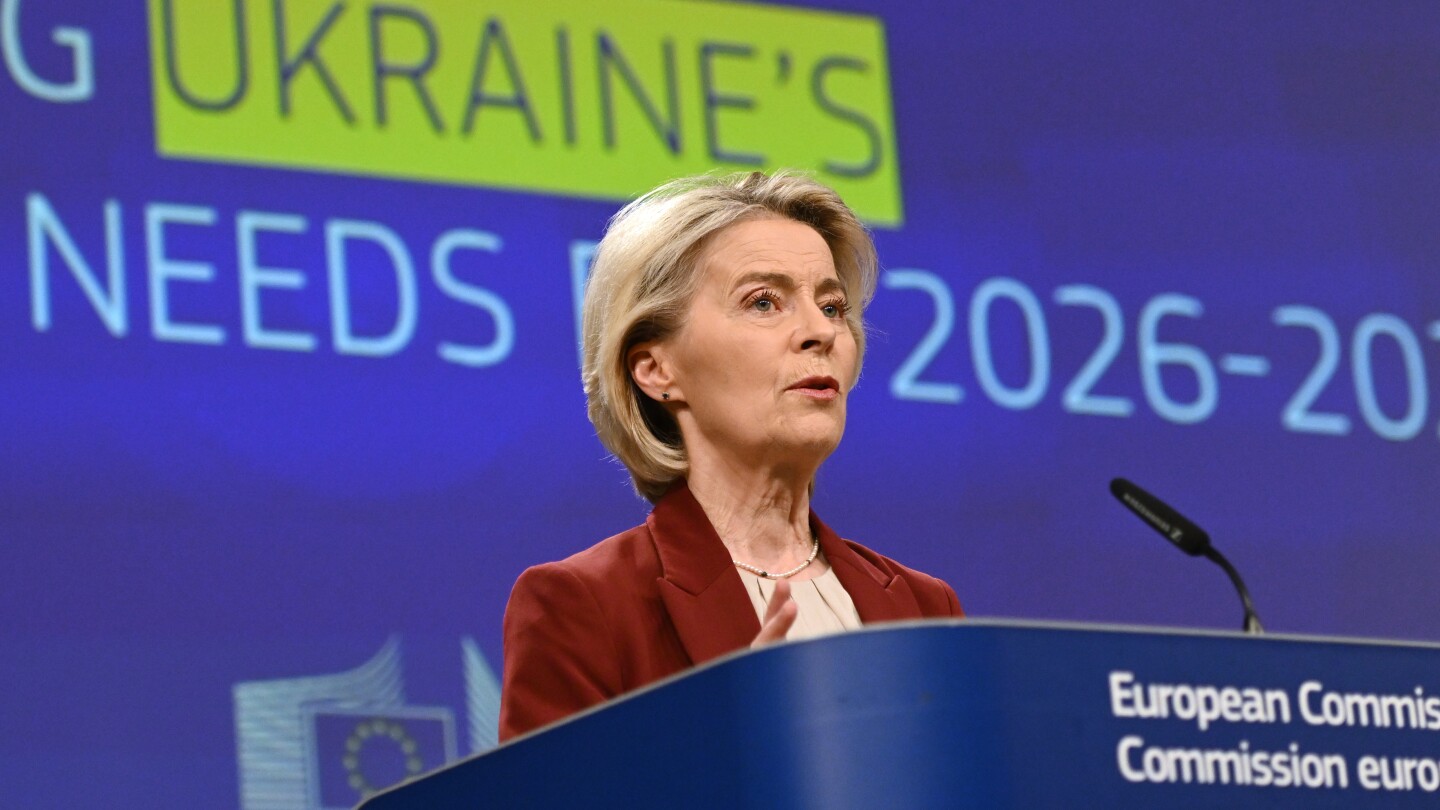
Unveiling her plan on Dec. 4, European Commission President Ursula von der Leyen said the EU would cover two-thirds of Ukraine’s needs for 2026 and 2027, for a total of 90 billion euros ($105 billion). International partners would fill the gap.

Due to EU sanctions on Russia’s assets, cash balances have accumulated at Euroclear. They’ve generated interest — some 3.9 billion euros ($4.5 billion) this year, Euroclear says — which is already being used to fund a Group of Seven loan plan for Ukraine.

Under the new plan, some of the cash would be transferred to an EU debt instrument. Ukraine would owe the EU the money but would repay only after the bloc’s sanctions are lifted and after Russia agrees to pay war reparations.

The commission insists that there is no “theft,” as Russia has claimed, because the right of the Russian Central Bank to make a claim on its money and Euroclear’s duty to repay will remain intact.

Once Putin pays war reparations, Ukraine would repay the EU, the EU would repay Euroclear, and Euroclear would repay the Russian Central Bank.

Opposition from Belgium

Importantly for Belgium, the plan contains safeguards to ensure that the risks would be shared by its partners. Other EU countries would offer to guarantee the loan if something went wrong. Germany has already signaled that it would do so.

But the Belgian government has not been assuaged. Even before the commission’s reparations loan plan was made public, Foreign Minister Maxime Prévot said that it “entails consequential economic, financial and legal risks.”

Prévot said Belgium — a strong backer of Ukraine that has provided military and financial support — feels that its concerns are not being heard by its EU partners.

“We are not seeking to antagonize our partners or Ukraine. We are simply seeking to avoid potential disastrous consequences for a member state that is being asked to show solidarity without being offered the same solidarity in return,” he said.

In an interview with Belgian public broadcaster RTBF last week, Euroclear CEO Valerie Urbain also said that court action could not be ruled out should the EU oblige the clearinghouse to transfer its Russian assets.


Source link

Share. Facebook Twitter Pinterest LinkedIn Tumblr Email Telegram Copy Link
admin
  • Website

Related Posts

Europe

Denmark plans to ban social media for children younger than 15

December 11, 2025
Europe

Verona’s ancient Roman arena gets a modern facelift for the 2026 Milan Cortina games

December 11, 2025
Europe

Anti-government protests spread across Bulgaria

December 10, 2025
Europe

Researchers uncover earliest known evidence of human fire-making in England

December 10, 2025
Europe

Ukraine’s Zelenskyy denies using war to delay elections, seeks US help

December 10, 2025
Europe

Zelenskyy says Ukraine ready for elections if safe vote is guaranteed

December 10, 2025
Add A Comment
Leave A Reply Cancel Reply

Editors Picks

Punjab sugar output tops 0.43m tonnes this season – Business & Finance

December 10, 2025

China continues to source nearly 51pc of global copper imports from global markets – Business & Finance

December 10, 2025

SNGPL’s profitability declines to Rs14.6bn in FY2025 – Business & Finance

December 10, 2025

Binance, JazzCash sign MoU for growth of virtual assets – Business & Finance

December 10, 2025
Latest Posts

PSX hits all-time high as proposed ‘neutral-to-positive’ budget well-received by investors – Business

June 11, 2025

Sindh govt to allocate funds for EV taxis, scooters in provincial budget: minister – Pakistan

June 11, 2025

US, China reach deal to ease export curbs, keep tariff truce alive – World

June 11, 2025

Subscribe to News

Subscribe to our newsletter and never miss our latest news

Subscribe my Newsletter for New Posts & tips Let's stay updated!

Recent Posts

  • Euro extends gains to two-month high on strong demand
  • Bitcoin drops below US$90,000 as AI worries sour risk appetite
  • South Korea to end cosmetic surgery tax break that fuelled medical tourism boom
  • Hegseth’s G2 description for US-China relations is ‘deeply problematic’, lawmaker says
  • Philippines denies ex-mayor Alice Guo has received special treatment in prison

Recent Comments

No comments to show.

Welcome to World-Economist.com, your trusted source for in-depth analysis, expert insights, and the latest news on global finance and economics. Our mission is to provide readers with accurate, data-driven reports that shape the understanding of economic trends worldwide.

Latest Posts

Euro extends gains to two-month high on strong demand

December 11, 2025

Bitcoin drops below US$90,000 as AI worries sour risk appetite

December 11, 2025

South Korea to end cosmetic surgery tax break that fuelled medical tourism boom

December 11, 2025

Subscribe to Updates

Subscribe to our newsletter and never miss our latest news

Subscribe my Newsletter for New Posts & tips Let's stay updated!

Archives

  • December 2025
  • November 2025
  • October 2025
  • September 2025
  • August 2025
  • July 2025
  • June 2025
  • May 2025
  • April 2025
  • March 2025
  • February 2025
  • January 2025
  • December 2024
  • June 2024
  • October 2022
  • March 2022
  • July 2021
  • February 2021
  • January 2021
  • November 2019
  • April 2011
  • January 2011
  • December 2007
  • July 2007

Categories

  • AI & Tech
  • Asia
  • Banking
  • Business
  • Business
  • China
  • Climate
  • Computing
  • Economist Impact
  • Economist Intelligence
  • Economy
  • Editor's Choice
  • Europe
  • Europe
  • Featured
  • Featured Business
  • Featured Climate
  • Featured Health
  • Featured Science & Tech
  • Featured Travel
  • Finance & Economics
  • Health
  • Highlights
  • Markets
  • Middle East
  • Middle East & Africa
  • Middle East News
  • Most Viewed News
  • News Highlights
  • Other News
  • Politics
  • Russia
  • Science
  • Science & Tech
  • Social
  • Space Science
  • Sports
  • Sports Roundup
  • Tech
  • This week
  • Top Featured
  • Travel
  • Trending Posts
  • Ukraine Conflict
  • Uncategorized
  • US Politics
  • USA
  • World
  • World & Politics
  • World Economy
  • World News
© 2025 world-economist. Designed by world-economist.
  • Home
  • About Us
  • Advertise With Us
  • Contact Us
  • DMCA
  • Privacy Policy
  • Terms & Conditions

Type above and press Enter to search. Press Esc to cancel.