
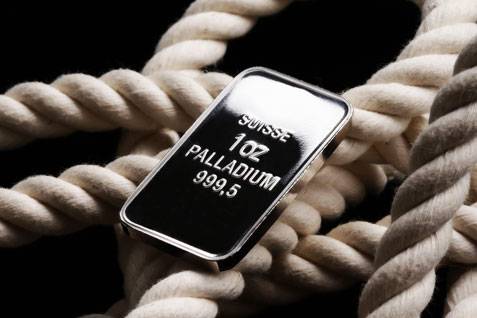
Palladium prices rose during Wednesday’s trading, supported by technical buying across several precious metals, most notably silver, which reached record highs, amid ongoing uncertainty surrounding US Federal Reserve policy.
Daily movements in palladium prices are influenced by the same factors that drive the broader precious metals complex, primarily US interest rate expectations, the strength of the dollar, and overall risk appetite among investors.
Reuters reported that investors remained cautious ahead of key US employment data, as well as upcoming inflation figures, prompting profit-taking across metals markets following a strong rally throughout 2025. In this context, palladium posted modest gains, while platinum remained relatively stable.
These developments are particularly significant given that palladium, like gold and silver, is globally priced. Expectations of lower interest rates or a weaker dollar tend to support non-yielding assets, while heightened sensitivity to economic data often leads to short-term risk reduction in metals markets.
Reuters also noted that delays and gaps in US economic data collection, caused by the government shutdown, have further complicated the macroeconomic outlook, adding an additional layer of uncertainty for traders positioning their portfolios.
European policy reassessment of internal combustion engines has emerged as a key medium-term demand driver for palladium.
On December 16, signals emerged that the European Commission may soften its stance on banning new internal combustion engine vehicles by 2035. According to Reuters, the Commission is preparing to revise the current plan by allowing the continued sale of certain non-fully electric vehicles, under pressure from major member states and the automotive industry.
Under proposals cited by the agency, the emissions reduction target could be adjusted from 100% to 90% by 2035 compared with 2021 levels, potentially extending the lifespan of plug-in hybrids and range-extender vehicles.
In a separate report, Reuters said the European Commission is also considering compensation mechanisms that would permit continued sales of combustion-engine vehicles beyond 2035 through the use of alternative fuels or green steel accounting.
This policy shift is highly relevant for palladium price expectations, given its close link to internal combustion engines, where it is used in catalytic converters to reduce harmful emissions in gasoline vehicles. Any extension in the lifecycle of combustion and hybrid vehicles in Europe could slow the erosion of palladium’s core demand base.
Reuters quoted a commodities strategist at WisdomTree as saying that such a policy shift would likely support internal combustion vehicles, which rely on palladium and platinum.
On the supply side, palladium market balance remains in focus, particularly following updated guidance from Russia’s Norilsk Nickel, the world’s largest palladium producer.
According to recent estimates, the company expects the palladium market to be broadly balanced in 2025 when excluding investment demand, but to show a deficit of around 200,000 ounces when investment demand is included. For 2026, Norilsk expects a deficit of approximately 100,000 ounces even without investment demand.
These distinctions are critical, as palladium is a relatively small and concentrated market, meaning shifts in investment flows or ETF demand can materially alter supply-demand dynamics and price sentiment.
In this context, a report from the Indian Bullion and Jewellers Association noted that palladium has risen by around 25% since the start of the latest rally, alongside strong gains in silver and platinum, illustrating how momentum has spread across the precious metals complex.
On pricing, market data showed NYMEX palladium futures for December 2025 trading near $1,592.8 per ounce, with notable intraday gains. Spot and futures prices can diverge depending on liquidity, short-term supply availability, and financing conditions.
Looking ahead, palladium’s strong performance in 2025 has prompted analysts to reassess their outlook for 2026, with the market caught between two competing narratives: structural support from constrained supply and policy developments that could extend demand for combustion engines, versus long-term headwinds from the expansion of fully electric vehicles and substitution risks.
Consensus projections point to a wide price range in 2026, with average estimates clustering around $1,250–$1,300 per ounce, reflecting elevated uncertainty following this year’s sharp rally.
During US trading hours, March-delivery palladium futures rose by 3.5% to $1,714.5 per ounce as of 16:52 GMT.
