

Close Menu
World Economist – Global Markets, Finance & Economic Insights
  • Home
  • Economist Impact
    • Economist Intelligence
    • Finance & Economics
  • Business
  • Asia
  • China
  • Europe
  • Economy
  • USA
    • Middle East & Africa
    • Highlights
  • This week
  • World Economy
    • World News
What's Hot

BYD’s win, Tesla’s defeat, Ford’s pivot: gap widens in US-China EV markets

January 8, 2026

Trump’s oil push widens with seizure of Russian-flagged tanker linked to Venezuela – World

January 8, 2026

Breaking | US won’t rule out pressuring Venezuela to curb China, Russia ties

January 8, 2026
Facebook X (Twitter) Instagram
Thursday, January 8
Facebook X (Twitter) Instagram
World Economist – Global Markets, Finance & Economic Insights
  • Home
  • Economist Impact
    • Economist Intelligence
    • Finance & Economics
  • Business
  • Asia
  • China
  • Europe
  • Economy
  • USA
    • Middle East & Africa
    • Highlights
  • This week
  • World Economy
    • World News
World Economist – Global Markets, Finance & Economic Insights
Home » China’s new quantum computer hits stability milestone, beating Google on efficiency
China

China’s new quantum computer hits stability milestone, beating Google on efficiency

adminBy adminDecember 26, 2025No Comments2 Mins Read
Share Facebook Twitter Pinterest Copy Link LinkedIn Tumblr Email VKontakte Telegram
Share
Facebook Twitter Pinterest Email Copy Link
Post Views: 11


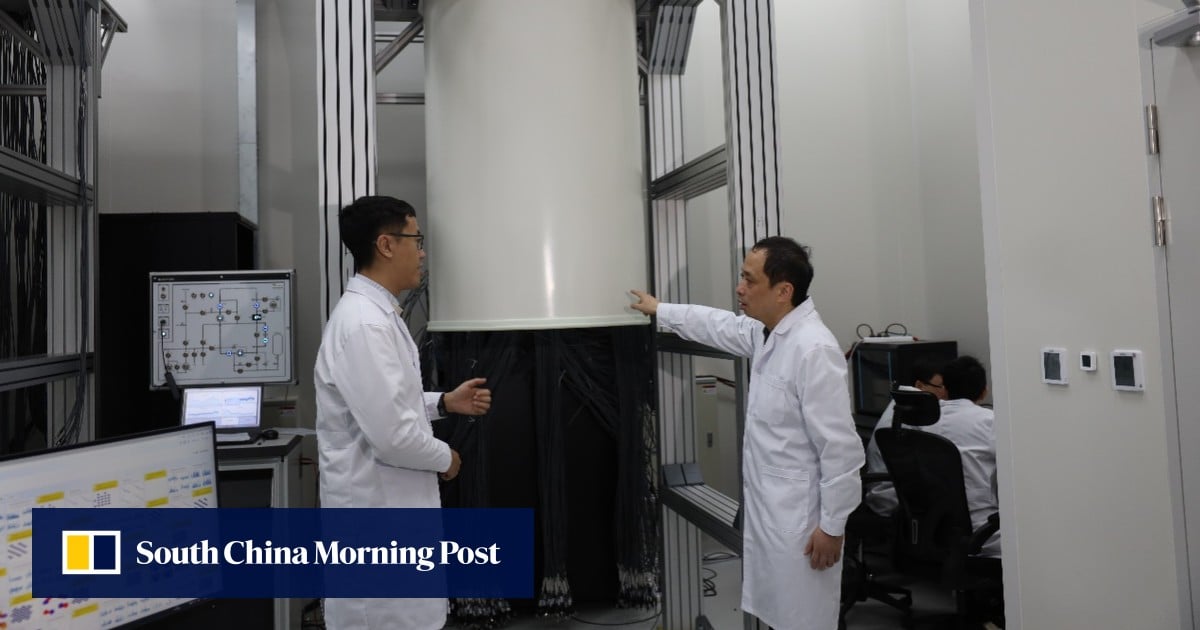
Chinese researchers have taken a major step in the global race to build practical quantum computers, becoming the first team outside the United States – and the second in the world after Google – to cross a key threshold that determines whether these machines can work reliably at scale.
A team led by Pan Jianwei at the University of Science and Technology of China said their superconducting quantum computer, Zuchongzhi 3.2, had reached the fault-tolerant threshold – a point where fixing errors made the system more stable rather than less, overcoming a long-standing problem in which the very process of error correction introduces new mistakes.

Their research, published last week in the journal Physical Review Letters, relied on microwave-based control rather than the hardware-intensive error-suppression methods used by Google. The Chinese approach “could offer a more efficient route than Google’s” to building large, fault-tolerant quantum computers, the team said in a statement on Monday.

Joseph Emerson, a physicist at the University of Waterloo in Canada who was not involved in the research, said the study tackled one of quantum computing’s most difficult problems: qubits drifting out of their intended states and quietly spreading errors through the system.

Writing in the American Physical Society’s Physics magazine, Emerson described the experiment as “an impressive feat”, while cautioning that it remained far from the scale needed for practical, real-world applications.
05:04

China creates analogue AI chip said to be 1,000 times faster than Nvidia GPU

China creates analogue AI chip said to be 1,000 times faster than Nvidia GPU

Quantum computers work by harnessing the laws of quantum physics rather than the simple on-off logic used by ordinary computers. In theory, this allows them to tackle certain tasks – such as optimising complex systems or simulating molecules – in minutes that would take today’s machines thousands of years to complete.


Source link

Share. Facebook Twitter Pinterest LinkedIn Tumblr Email Telegram Copy Link
admin
  • Website

Related Posts

China

BYD’s win, Tesla’s defeat, Ford’s pivot: gap widens in US-China EV markets

January 8, 2026
China

Breaking | US won’t rule out pressuring Venezuela to curb China, Russia ties

January 8, 2026
China

Will Donald Trump’s threats to Greenland help bring China and Europe closer together?

January 8, 2026
China

China blasts US for ‘blatant interference’ after Donald Trump claims Venezuela’s oil

January 7, 2026
China

The US, Venezuela and why China is even less keen on talk of a G2

January 7, 2026
China

Why China may want to avoid direct confrontation with US after Venezuela raid

January 7, 2026
Add A Comment
Leave A Reply Cancel Reply

Editors Picks

Trump’s oil push widens with seizure of Russian-flagged tanker linked to Venezuela – World

January 8, 2026

India bonds end flat after RBI’s debt purchase let-down – Markets

January 7, 2026

PM Shehbaz orders SBP to simplify loan process for SMEs, agricultural sector – Business & Finance

January 7, 2026

Surge in defence orders could end Pakistan’s reliance on IMF, says Khawaja Asif – Business & Finance

January 7, 2026
Latest Posts

PSX hits all-time high as proposed ‘neutral-to-positive’ budget well-received by investors – Business

June 11, 2025

Sindh govt to allocate funds for EV taxis, scooters in provincial budget: minister – Pakistan

June 11, 2025

US, China reach deal to ease export curbs, keep tariff truce alive – World

June 11, 2025

Subscribe to News

Subscribe to our newsletter and never miss our latest news

Subscribe my Newsletter for New Posts & tips Let's stay updated!

Recent Posts

  • BYD’s win, Tesla’s defeat, Ford’s pivot: gap widens in US-China EV markets
  • Trump’s oil push widens with seizure of Russian-flagged tanker linked to Venezuela – World
  • Breaking | US won’t rule out pressuring Venezuela to curb China, Russia ties
  • Nikkei 225, Hang Seng Index
  • Will Donald Trump’s threats to Greenland help bring China and Europe closer together?

Recent Comments

No comments to show.

Welcome to World-Economist.com, your trusted source for in-depth analysis, expert insights, and the latest news on global finance and economics. Our mission is to provide readers with accurate, data-driven reports that shape the understanding of economic trends worldwide.

Latest Posts

BYD’s win, Tesla’s defeat, Ford’s pivot: gap widens in US-China EV markets

January 8, 2026

Trump’s oil push widens with seizure of Russian-flagged tanker linked to Venezuela – World

January 8, 2026

Breaking | US won’t rule out pressuring Venezuela to curb China, Russia ties

January 8, 2026

Subscribe to Updates

Subscribe to our newsletter and never miss our latest news

Subscribe my Newsletter for New Posts & tips Let's stay updated!

Archives

  • January 2026
  • December 2025
  • November 2025
  • October 2025
  • September 2025
  • August 2025
  • July 2025
  • June 2025
  • May 2025
  • April 2025
  • March 2025
  • February 2025
  • January 2025
  • December 2024
  • June 2024
  • March 2024
  • October 2022
  • March 2022
  • July 2021
  • February 2021
  • January 2021
  • November 2019
  • April 2011
  • January 2011
  • December 2007
  • July 2007

Categories

  • AI & Tech
  • Asia
  • Banking
  • Business
  • Business
  • China
  • Climate
  • Computing
  • Economist Impact
  • Economist Intelligence
  • Economy
  • Editor's Choice
  • Europe
  • Europe
  • Featured
  • Featured Business
  • Featured Climate
  • Featured Health
  • Featured Science & Tech
  • Featured Travel
  • Finance & Economics
  • Health
  • Highlights
  • Markets
  • Middle East
  • Middle East & Africa
  • Middle East News
  • Most Viewed News
  • News Highlights
  • Other News
  • Politics
  • Russia
  • Science
  • Science & Tech
  • Social
  • Space Science
  • Sports
  • Sports Roundup
  • Tech
  • This week
  • Top Featured
  • Travel
  • Trending Posts
  • Ukraine Conflict
  • Uncategorized
  • US Politics
  • USA
  • World
  • World & Politics
  • World Economy
  • World News
© 2026 world-economist. Designed by world-economist.
  • Home
  • About Us
  • Advertise With Us
  • Contact Us
  • DMCA
  • Privacy Policy
  • Terms & Conditions

Type above and press Enter to search. Press Esc to cancel.