


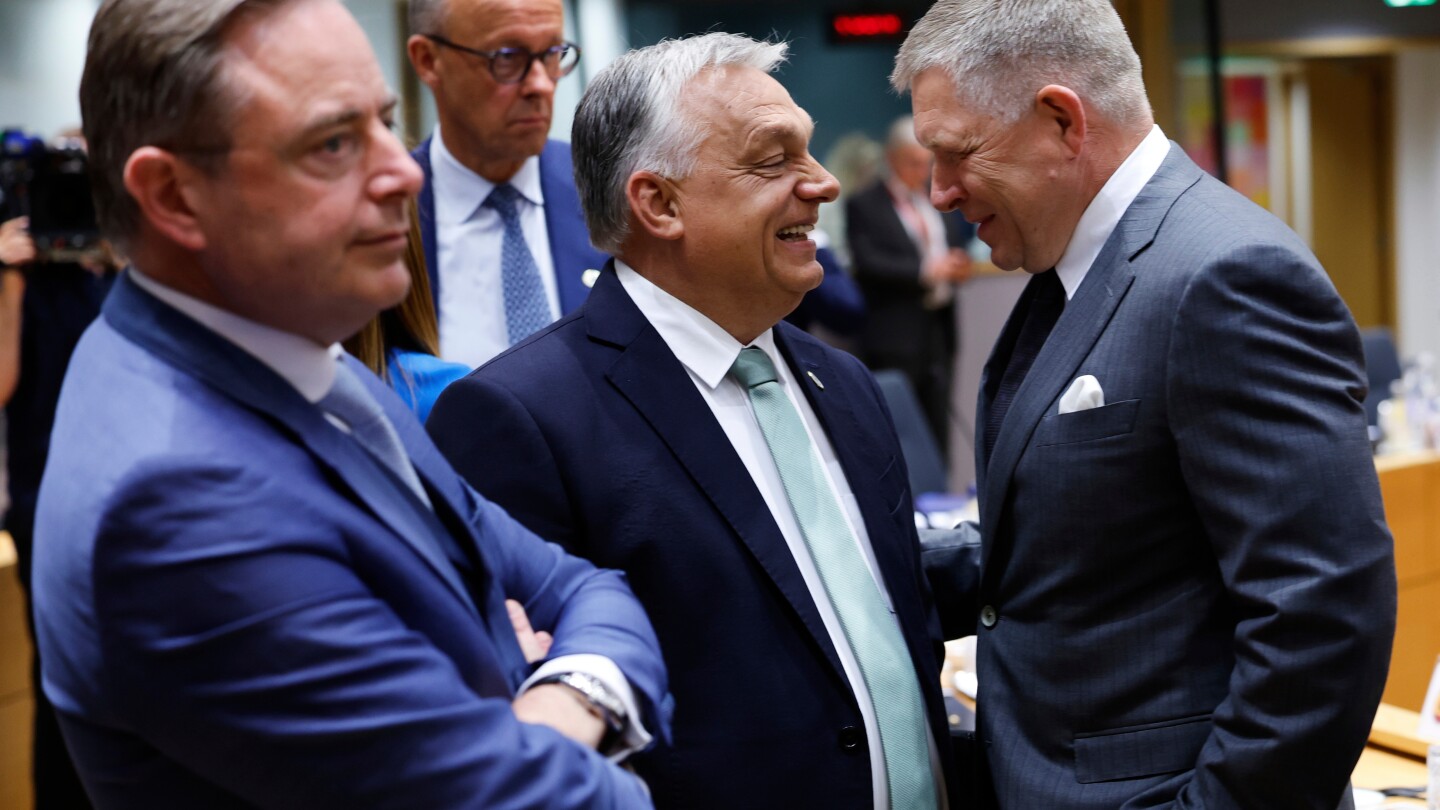
BRUSSELS (AP) — For decades, Belgium has been at the beating heart of the European Union. The headquarters of the 27-nation bloc’s main institutions and NATO are based there. EU leaders meet in the capital Brussels at least four times a year.
But at Thursday’s EU summit of presidents and government leaders, Belgium and its prime minister were at the heart of political tensions that could send ripples across the world’s biggest trading bloc for years to come.
The tensions arise from a plan to use frozen Russian assets to fund Ukraine’s military and economic needs for the next two years. Most of that money is blocked at Euroclear, a Brussels-based financial clearinghouse.
Belgium fears that Russia will strike back; in the courts or perhaps by other means.
Prime Minister Bart De Wever — whose political ambition before taking office in February was to break up Belgium, gut its state structures and grant more autonomy to his northern Flanders region — wants Europe to unite around his concerns.
The reparations loan plan, De Wever told Belgian lawmakers on Thursday, “drastically increases the risk of Russian retaliation. It’s not acceptable that this happens to Belgium alone. If we jump, we jump together.”
The money blocked at Euroclear — 193 billion euros ($226 billion) as of September — equals almost a third of the kingdom’s gross domestic product. Belgium is mired in debt, among the worst financial performers in the EU.
For months, De Wever struggled to chaperone his five-party coalition into agreeing on a budget. Those torturous negotiations only ended recently, making it tricky for him to agree on a loan to Ukraine that might hurt Belgium’s finances.
As the “reparations loan” plan was being devised, his government regularly highlighted its vulnerability to retaliation.
After EU leaders last debated the assets in October, Belgian Defense Minister Theo Francken said that a series of drone incidents at Belgium’s airports and military bases appeared to be “a spying operation” aimed at “destabilizing” people. The culprits were never identified.
Ahead of Thursday’s summit, Belgian officials underlined how the Russian Central Bank last Friday had sued Euroclear for more money than the clearinghouse is actually holding, and warned that more could come.
Some EU nations believe that De Wever has been too vocal about his opposition to the loans and backed himself into a corner that he will struggle to escape from without embarrassment at home.
Ukrainian President Volodymyr Zelenskyy said he understands “the risks that he is talking about, but I think that we face bigger risks.” He added that “Ukraine has the right to this money because Russia is destroying us.”
With Belgium standing firm, the question for its EU partners is whether to simply forge ahead without De Wever’s consent. Ukraine needs the money early next year, and even Belgium agrees that the EU must find the funds soon.
At least nine countries would have to object to prevent the loans and no blocking minority has yet emerged.
But running roughshod over Belgium, particularly over a founding EU member country with much at stake, could undermine EU decision-making. Majorities would surely be harder to form in the future and other countries might be more inclined to use their vetoes.
“Let us not deceive ourselves. If we do not succeed in this, the European Union’s ability to act will be severely damaged for years, if not for a longer period,” German Chancellor Friedrich Merz said of the loan plan on Monday.
The question for De Wever is whether the legal and financial costs Belgium could suffer would outweigh the costs of undermining his country’s credibility with his European partners, and with Ukraine.
Whatever path is taken, summit chairman EU Council President António Costa has vowed to keep leaders negotiating until a funding deal is clinched, even if it takes days. It seems within De Wever’s power to achieve that before he turns 55 on Sunday.
