

Close Menu
World Economist – Global Markets, Finance & Economic Insights
  • Home
  • Economist Impact
    • Economist Intelligence
    • Finance & Economics
  • Business
  • Asia
  • China
  • Europe
  • Economy
  • USA
    • Middle East & Africa
    • Highlights
  • This week
  • World Economy
    • World News
What's Hot

Targeted jamming incident blinds GPS and BeiDou in east China’s Nanjing

December 20, 2025

Fake and low-quality pesticides plague Punjab, Sindh, finds CCP report – Business & Finance

December 20, 2025

China’s ‘black flying’ drone dilemma: when tech advancement clashes with aviation safety

December 20, 2025
Facebook X (Twitter) Instagram
Saturday, December 20
Facebook X (Twitter) Instagram
World Economist – Global Markets, Finance & Economic Insights
  • Home
  • Economist Impact
    • Economist Intelligence
    • Finance & Economics
  • Business
  • Asia
  • China
  • Europe
  • Economy
  • USA
    • Middle East & Africa
    • Highlights
  • This week
  • World Economy
    • World News
World Economist – Global Markets, Finance & Economic Insights
Home » Climate change made heat and dryness that fueled Iberian wildfires 40 times more likely, study finds
Europe

Climate change made heat and dryness that fueled Iberian wildfires 40 times more likely, study finds

adminBy adminSeptember 4, 2025No Comments4 Mins Read
Share Facebook Twitter Pinterest Copy Link LinkedIn Tumblr Email VKontakte Telegram
Share
Facebook Twitter Pinterest Email Copy Link
Post Views: 47


MADRID (AP) — The extremely hot, dry and windy conditions, which fueled one of the IberianPeninsula’s most destructive wildfire seasons in recorded history, were 40 times more likely due to climate change, according to a study released Thursday.

The analysis by World Weather Attribution, or WWA, said the weather conditions were about 30% more intense compared to the preindustrial era, when heavy reliance on fossil fuels began.

Summer wildfires

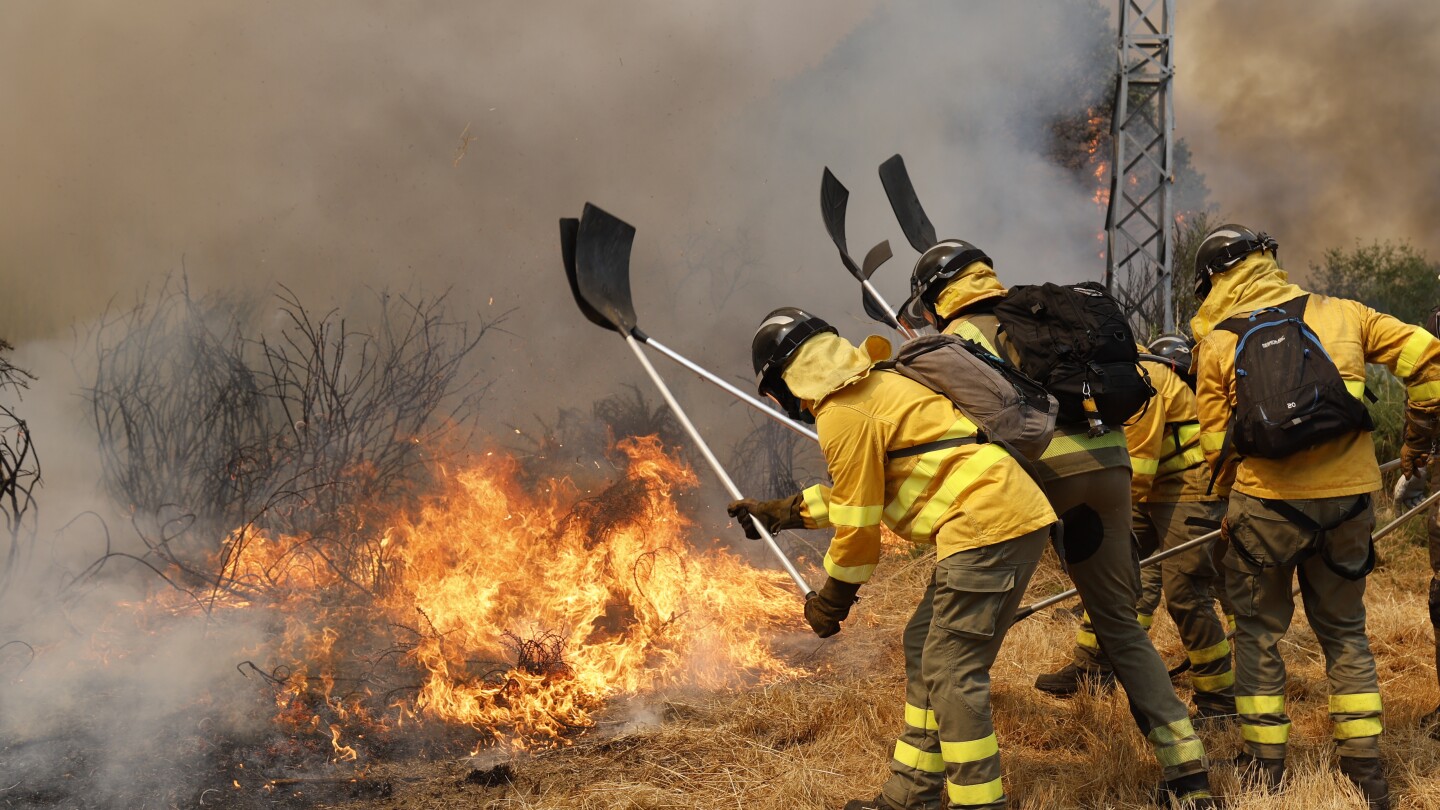
Hundreds of wildfires in the Iberian Peninsula broke out in July and August. They spread rapidly thanks to temperatures that pushed above 40 degrees Celsius (104 Fahrenheit) and strong winds.

The fires in Spain and Portugal killed eight people, forced more than 35,000 evacuations and scorched more than 640,000 hectares (1.58 million acres) or roughly two-thirds of Europe’s total burned area this year.

Most blazes are now under control, officials say, as temperatures have dropped considerably.

“Hotter, drier and more flammable conditions are becoming more severe with climate change, and are giving rise to fires of unprecedented intensity,” said Clair Barnes, a researcher at the Centre for Environmental Policy at Imperial College, London.

Europe has been warming twice as fast as the global average since the 1980s, according to the European Union’s Copernicus Climate Change Service.

The role of climate change

WWA, a group of researchers that examines whether and to what extent extreme weather events are linked to climate change, focused on the conditions that allowed the Iberian wildfires to spread that fast, including during Spain’s hottest ten-day period on record in August, according to the country’s weather agency AEMET.

Without climate change, similar ten-day spells of hot, dry and windy conditions would be rare, expected once every 500 years, they found.

“This quick study is one more line of evidence showing how human-caused climate change increases the frequency and intensity of extreme heat and combined hot and dry fire weather conditions,” said Valérie Masson-Delmotte, a climate scientist at the French Alternative Energies and Atomic Energy Commission, who was not involved in the study.

WWA’s analysis wasn’t a full attribution study. Those seek to determine the influence of climate change, driven primarily by the burning of fossil fuels, on a specific extreme weather event. This time, the researchers looked at weather observations without using climate models. But the results were consistent with existing research on wildfires in the region, the researchers said, and another study WWA recently published on this year’s fires in Turkey, Greece and Cyprus, which found that climate change made fire-prone weather conditions there 10 times more likely.

“While fires are a characteristic of the Mediterranean climate, human-caused climate change increases the recurrence and severity of conditions favorable for intense fires, making fire control efforts much more challenging,” Masson-Delmotte said.

Neglecting rural areas

The researchers mentioned other factors that have contributed to the severity of the wildfires, including large population shifts that have taken place over decades in Spain and Portugal from the countryside to cities. The study said this has resulted in large areas of neglected overgrown farms and forests, which further fuel the fires.

Removing vegetation using machinery, encouraging grazing by sheep, horses and goats and using other methods, such as controlled burns, would reduce the risk during wildfire seasons, researchers said.

“From a human perspective, most of these rural areas have suffered massive abandonment since the 1970s, which has allowed fine fuels to accumulate to dangerous levels, a problem worsened by inadequate forestry management,” said Ricardo Trigo, a professor at the University of Lisbon’s geophysics, geographical engineering and energy department.

On Monday, Spanish Prime Minister Pedro Sánchez proposed a 10-point plan to better prepare the country for natural disasters made worse by climate change. It included coordinating with neighboring Portugal and France.


Source link

Share. Facebook Twitter Pinterest LinkedIn Tumblr Email Telegram Copy Link
admin
  • Website

Related Posts

Europe

Odesa port hit by Russian missile as US hosts a Russian envoy for talks

December 20, 2025
Europe

Prisoners freed by Belarus say their passports are taken away in a final ‘dirty trick’ by officials

December 20, 2025
Europe

Ukrainian artist creates a living record of invasion

December 20, 2025
Europe

What to know about the EU’s new $106 billion loan to Ukraine

December 19, 2025
Europe

Zelenskyy signals good will to Polish president with Warsaw visit

December 19, 2025
Europe

Louvre reopens fully after staff vote to suspend strike

December 19, 2025
Add A Comment
Leave A Reply Cancel Reply

Editors Picks

Fake and low-quality pesticides plague Punjab, Sindh, finds CCP report – Business & Finance

December 20, 2025

Musk wins US court appeal of $56bn Tesla pay package – World

December 20, 2025

Main Line-1: ADB official, Abbasi discuss upgradation – Business & Finance

December 20, 2025

Dar briefed over strategies to enhance IT exports – Business & Finance

December 20, 2025
Latest Posts

PSX hits all-time high as proposed ‘neutral-to-positive’ budget well-received by investors – Business

June 11, 2025

Sindh govt to allocate funds for EV taxis, scooters in provincial budget: minister – Pakistan

June 11, 2025

US, China reach deal to ease export curbs, keep tariff truce alive – World

June 11, 2025

Subscribe to News

Subscribe to our newsletter and never miss our latest news

Subscribe my Newsletter for New Posts & tips Let's stay updated!

Recent Posts

  • Targeted jamming incident blinds GPS and BeiDou in east China’s Nanjing
  • Fake and low-quality pesticides plague Punjab, Sindh, finds CCP report – Business & Finance
  • China’s ‘black flying’ drone dilemma: when tech advancement clashes with aviation safety
  • China’s ‘black flying’ drone dilemma: when tech advancement clashes with aviation safety
  • China’s ‘black flying’ drone dilemma: when tech advancement clashes with aviation safety

Recent Comments

No comments to show.

Welcome to World-Economist.com, your trusted source for in-depth analysis, expert insights, and the latest news on global finance and economics. Our mission is to provide readers with accurate, data-driven reports that shape the understanding of economic trends worldwide.

Latest Posts

Targeted jamming incident blinds GPS and BeiDou in east China’s Nanjing

December 20, 2025

Fake and low-quality pesticides plague Punjab, Sindh, finds CCP report – Business & Finance

December 20, 2025

China’s ‘black flying’ drone dilemma: when tech advancement clashes with aviation safety

December 20, 2025

Subscribe to Updates

Subscribe to our newsletter and never miss our latest news

Subscribe my Newsletter for New Posts & tips Let's stay updated!

Archives

  • December 2025
  • November 2025
  • October 2025
  • September 2025
  • August 2025
  • July 2025
  • June 2025
  • May 2025
  • April 2025
  • March 2025
  • February 2025
  • January 2025
  • December 2024
  • June 2024
  • March 2024
  • October 2022
  • March 2022
  • July 2021
  • February 2021
  • January 2021
  • November 2019
  • April 2011
  • January 2011
  • December 2007
  • July 2007

Categories

  • AI & Tech
  • Asia
  • Banking
  • Business
  • Business
  • China
  • Climate
  • Computing
  • Economist Impact
  • Economist Intelligence
  • Economy
  • Editor's Choice
  • Europe
  • Europe
  • Featured
  • Featured Business
  • Featured Climate
  • Featured Health
  • Featured Science & Tech
  • Featured Travel
  • Finance & Economics
  • Health
  • Highlights
  • Markets
  • Middle East
  • Middle East & Africa
  • Middle East News
  • Most Viewed News
  • News Highlights
  • Other News
  • Politics
  • Russia
  • Science
  • Science & Tech
  • Social
  • Space Science
  • Sports
  • Sports Roundup
  • Tech
  • This week
  • Top Featured
  • Travel
  • Trending Posts
  • Ukraine Conflict
  • Uncategorized
  • US Politics
  • USA
  • World
  • World & Politics
  • World Economy
  • World News
© 2025 world-economist. Designed by world-economist.
  • Home
  • About Us
  • Advertise With Us
  • Contact Us
  • DMCA
  • Privacy Policy
  • Terms & Conditions

Type above and press Enter to search. Press Esc to cancel.