


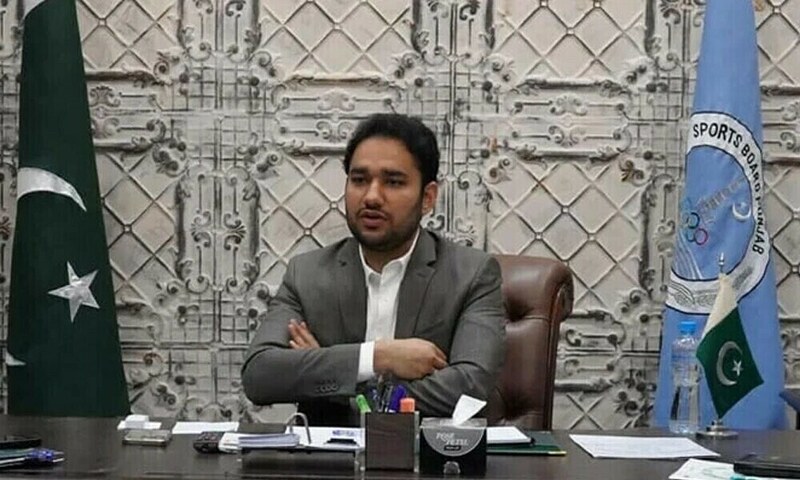
LAHORE: Punjab Minister for Energy and Sports, Faisal Ayub Khokhar discussed in detail with members of APTMA about deindustrialisation in Punjab due to exorbitant energy costs and explored ways and means to provide energy at affordable tariff.
The minister visited APTMA along with Dr Farrukh Naveed, Secretary Energy, Muhammad Majid Iqbal, Additional Secretary Energy Department and Sanyia Awais, MD Punjab Power Development Board. On his arrival at APTMA, he was received by Kamran Arshad Chairman APTMA, Asad Shafi Chairman North and leading textile exporters and manufacturers including Ahmad Shafi Vice Chairman, Mian Muhammad Shakeel, Haroon Ellahi Shaikh, Muhammad Ali, S M Nabeel, Bilal Danish, Faisal Jawed, Danish Aslam, Ahsan Shahid, S M Raffay, senior executives and the Secretary General Raza Baqir along with many other members of the Association.
Energy Minister Faisal Khokhar said the provincial government would positively consider all options to resolve energy issues being faced by textile industry. He said that both Federal and Punjab governments were working on multiple options to revitalize industry in general and export oriented sectors in particular.
Faisal assured that the provincial government would always fight for rights of industry and to lower power tariff. He continued there is proposal of converting coal power plants on indigenous coal instead of imported coal to bring down energy cost. Besides, all educational institutions, hospitals and social departments are being solarised. He added multiple options are under consideration of both the federal and provincial governments to bring down energy cost in the country.
He made it clear that industry was priority number one of the government. He said no country can make progress without utilizing full potential of industry as the industry bolsters economy, generates employment, enhances tax collection and upsurge exports. He said that the industry in Punjab is at disadvantage as other provinces have more natural resources like gas, water, coal and wind to produce cheaper electricity.
He expressed the hope that this difference would get mitigated in future with more prudent utilisation of resources available with Punjab.
Faisal continued that a strong industrial sector requires concerted efforts by the government, banks, industry and trade organizations to foster meaningful dialogues serving as a platform for critical thought. He said that the governments are required to set up sharper, more responsive financing solution aligned with real industry needs and greater openness to new models, risk sharing tool and innovation in export and energy finance.
The minister announced forming of joint APTMA-Energy Department Committee consisting of Provincial Secretary Energy, Central and Zonal Chairmen of APTMA to examine options for supply of cheaper energy.
Speaking on the occasion, Patron in Chief APTMA Gohar Ejaz said the goal of uplifting exports requires Regionally Competitive Energy Tariff (RCET). He said that, with regional tariff, Pakistan can fetch USD 10 billion additional on exports of textiles.
He supported the idea of supplying electricity to the export-oriented industry by activating 1300 megawatt Trimmu Power Plant in the province of Punjab and dedicating it to the industry only. He urged Punjab government to lay dedicated transmission line from Trimmu power plant to industrial estates and textile clusters. He said that the entire industry in Punjab does not require more than 2000 MW of electricity and production capacity of Punjab government-owned plants is about 2400 MWs which is enough to supply cheaper energy to the whole industry.
He said that with prudent approach, these plants can supply energy at the cost of about Rs. 15/Kw without adding wheeling charges.
Gohar offered from APTMA to install solar power plants across the province and wind power plants in Pothohar and Rajanpur. He said that cheaper electricity can be supplied to industrial estates and clusters through dedicated distribution line to be erected by Punjab government.
Speaking on the occasion, Kamran Arshad Chairman APTMA gave an overview of Pakistan’s textile industry, major issues faced by the industry especially excessive energy cost and way forward for enhancing coordination with the provincial government. He also presented USD 50 billion textile export vision through setting up of 1000 garments plant with plug and play facilities in dedicated Apparel Parks. He sought assistance from the provincial government for development of the proposed apparel Parks which would not only boost exports but also generate employment opportunities for millions of workers directly and indirectly to help in poverty alleviation and uplift foreign exchange reserves.
Highlighting export potential of Pakistan, Kamran informed that Pakistan has witnessed impressive growth in value added textile sectors. He added that more than 70 percent of Pakistan’s exports consisted of knitwear, garments, bed wear and towels. Value added exports have registered marvelous growth during the last decade especially after GSP Plus granted to Pakistan by EU. He said with he provision of energy and affordable cost, Pakistan’s exports would register unprecedented growth.
Asad Shafi, Chairman North highlighted massive improvements achieved by textile industry of Pakistan and compliance of all UN conventions especially relating to labour and human rights, good governance, environment and emission control. He said that Pakistan has launched a National Compliance Centre which will work with business community to improve understanding of international compliance requirements and to promote a culture of equitable growth and discrimination free workplace.
Copyright Business Recorder, 2025
