
The government has signed a $2 billion real-world asset tokenisation agreement with Binance Investments, one of the world’s leading blockchain and digital asset technology companies, marking Pakistan’s first formal step into blockchain-based distribution of sovereign assets. However, questions have emerged over the transparency of the selection process and the absence of leading global asset tokenisation players in the initiative.
The concerns were raised by Asad Umar, former finance minister, in a post on the social media platform X, on Saturday.
“A real-world asset tokenisation agreement worth $2 billion was signed between GOP and Binance. What process was used to select Binance? It is neither a major player in asset tokenisation globally nor carries a high level of credibility for this task,” wrote Umar.
The former finance minister questioned the incumbent government, whether the leading global players in asset tokenisation, including BlackRock, UBS, Goldman Sachs, JP Morgan, and HSBC, were invited to participate in the process.
“This is Pakistan’s entry into digital tokenisation and the first transaction will establish credibility and long-term success,” said Umar, stressing that it’s essential that decision-making is done through a transparent process.
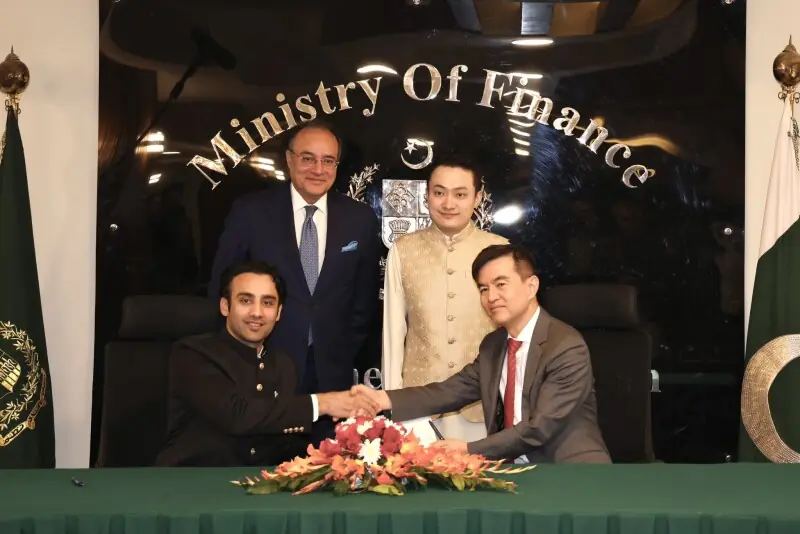
The Ministry of Finance on Friday signed a Memorandum of Understanding (MoU) with Binance Investments Co., Ltd. The MoU was signed at the Finance Division by Federal Minister for Finance and Revenue, Muhammad Aurangzeb, and Richard Teng, CEO of Binance, in the presence of Changpeng Zhao (CZ), Adviser to the Pakistan Crypto Council.
The MoU establishes a framework for exploring potential collaboration on the tokenisation and blockchain-based distribution of Pakistan’s real-world and sovereign assets, including government bonds, treasury bills, commodity reserves, and other federally owned assets.
Subject to applicable laws, policies, and regulatory approvals, the initiative may involve assets of up to $2 billion to enhance liquidity, transparency, and international market accessibility.
