


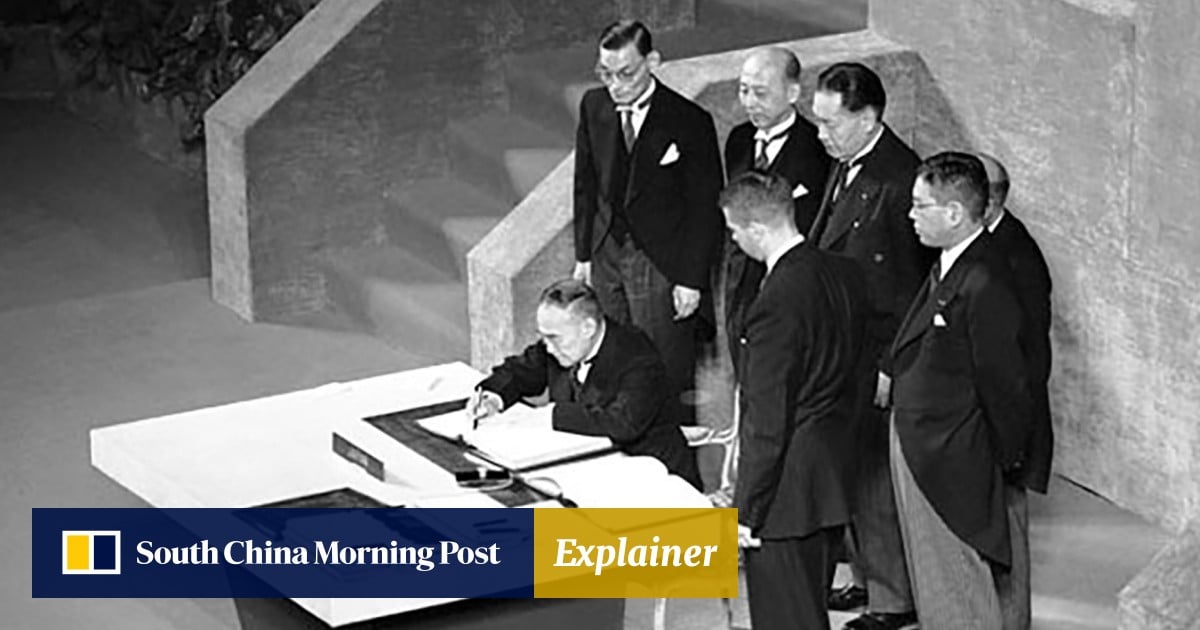
Beijing regards Taiwan’s restoration as a key outcome of the treaties and agreements that established the framework of international norms in place since the end of the Second World War.
Why does it matter?
Taiwan was a colony of Japan from 1895 to 1945, along with the Penghu Islands, after China’s Qing government was forced to cede them under the Treaty of Shimonoseki, or the Treaty of Maguan, signed after China lost the first Sino-Japanese war.
In the 1943 Cairo Declaration, the US, Britain and China stated explicitly that all the territories Japan had stolen from the Chinese were to be restored, including Taiwan and the Penghu Islands.

04:47
Why have Takaichi’s Taiwan comments sent China-Japan ties into a tailspin?
Why have Takaichi’s Taiwan comments sent China-Japan ties into a tailspin?
The Potsdam Proclamation in 1945 reaffirmed this position and set the conditions for Japan’s surrender. Later that year, Japan formally accepted these terms in its surrender instrument.
