


NAGASAKI, Japan (AP) — Hundreds of prisoners of war from Allied countries were held at brutal Japanese camps in Nagasaki when the United States dropped an atomic bomb 80 years ago.
Their presence during the Aug. 9, 1945, bombing is little known, and family and researchers have been collecting and publishing testimonies to tell the stories of these often unrecognized victims.
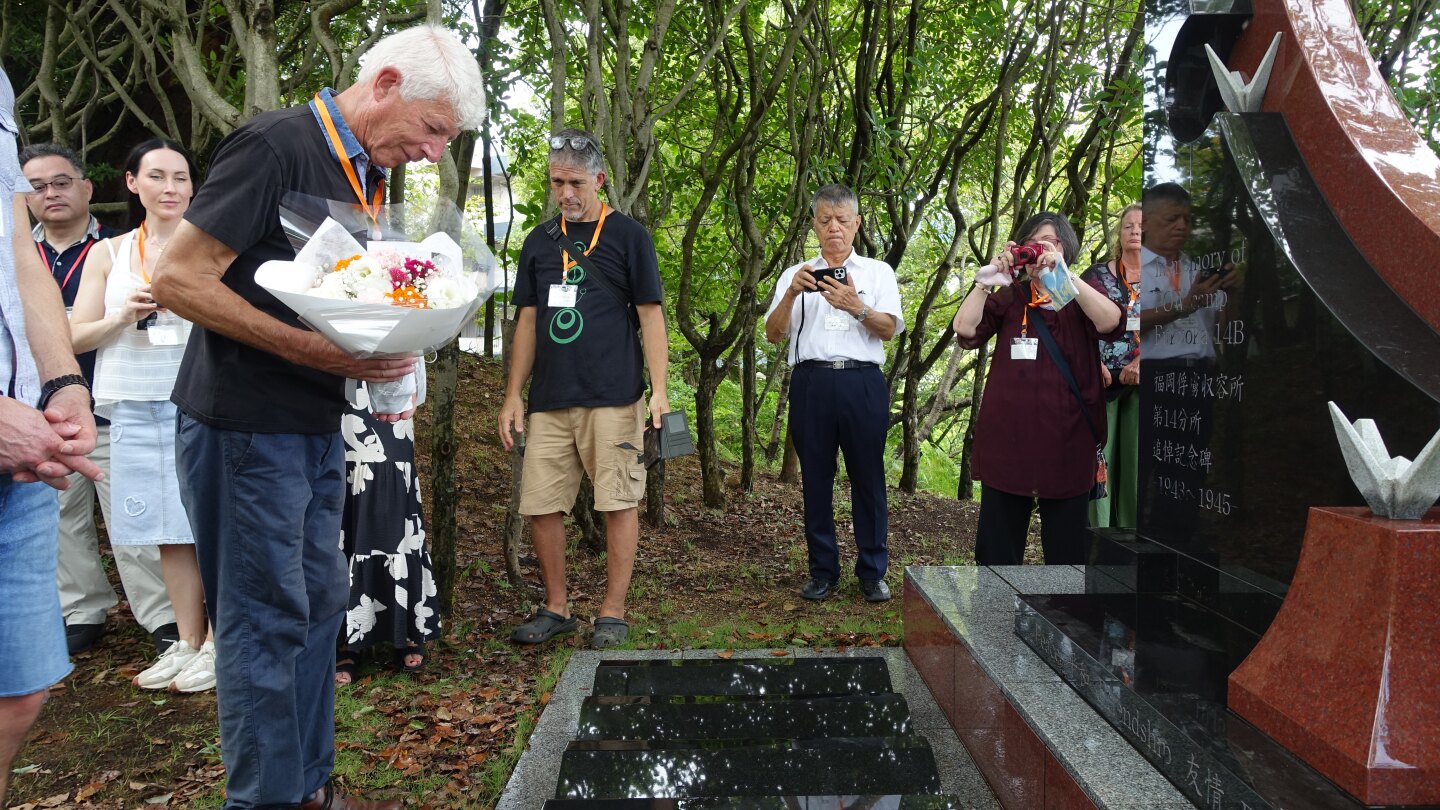
In September, dozens of relatives of Dutch POWs and descendants of Japanese bombing survivors came together to commemorate both those who were abused at the camps and the tens of thousands of Japanese who were killed that day. The dead included at least eight captives at one of the Nagasaki camps.
Descendants and survivors reckon with a painful past
Andre Schram, who represented the Dutch families at the Nagasaki memorial, unveiled in 2015, is the son of a sailor who was among nearly 1,500 POWs held at the Fukuoka No. 2 Branch Camp for three years and forced to work at the Kawanami shipyard.
Many of the prisoners were Dutch service members captured by the Japanese in Indonesia, transported to Nagasaki on so-called “hell ships,” kept at two major camps -– No. 2 and No. 14 — and used as slave labor.
About 150,000 Allied prisoners were held in dozens of camps across Asia during the war, including 36,000 sent to Japan to make up for labor shortage as Japanese men were drafted and deployed to battlefields across Asia, according to the POW Research Network Japan.
Stay up to date with the news and the best of AP by following our WhatsApp channel.
Follow on

There were also prisoners from the United States, Britain and Australia in Nagasaki. None died from the atomic blast at the No. 2 Camp, but more than 70 earlier died of malnutrition, overwork and illness.
Andre Schram’s father, Johan Willem Schram, returned to the Netherlands four months after the war ended, but only near the end of his life did he tell his son about being treated like a slave. Japanese officials have apologized multiple times for wartime atrocities, “but Johan, like many other victims, had doubts about their sincerity,” his son said.
“He felt Japan and the Netherlands treated him and other prisoners of war with disrespect. He never wanted anything to do with Japan again,” Andre Schram wrote in “Johan’s Story,” a booklet about the Netherlands’ colonial rule of the Dutch East Indies, the war with Japan and the aftermath, based on his research after his father died in 1993.
Peter Klok said his father, Leendert Klok, also a Dutch POW at the camp, told him that Japanese civilians at the shipyard were friendly and helped him find parts to repair his watch. Military police later beat him for seeking help.
Klok called the atomic bombings of Hiroshima and Nagasaki awful, but said Japan must reflect on its atrocities.
A blinding flash, violent explosions, then the end of the war
When the U.S. B-29 dropped the “Fat Man” plutonium bomb on Nagasaki, prisoners at the No. 2 Camp, about 10 kilometers (6.2 miles) from ground zero, saw a huge orange fireball, purple smoke and a triple-layer mushroom cloud, British captive Tom Humphrey wrote in his diary, part of which is quoted on the Royal Air Force website.
Windows at the camp were shattered, doors were blasted off and the clinic ceiling collapsed, he wrote.
The other camp, Fukuoka No. 14, was much closer to the blast. The brick buildings were destroyed, killing eight and injuring dozens.
A former Dutch captive, Rene Schafer recalled that he and his fellow prisoners were digging a new shelter when Japanese soldiers warned of U.S. aircraft approaching. They jumped into a bunker, but his roommate suffered severe burns and died nine days later.
Australian survivor Peter McGrath-Kerr was reading when everyone bolted to shelters. A fellow Australian captive dug him out from the debris, but he was unconscious for five days with broken ribs, cuts and bruises and radiation burns on his hand.
Researchers examine a largely neglected history
In the days that followed the atomic bombing, prisoners from the Fukuoka No. 2 Camp provided rice and other assistance to their comrades from the No. 14 Camp.
Schram’s father and fellow POWs at the No. 2 Camp were officially notified of Japan’s surrender on Aug. 18, and a U.S. B-29 delivered its first food drop for the Allied POWs on Aug. 26.
On Sept. 13, the prison camp survivors left Nagasaki, heading for the Philippines on a U.S. carrier.
The ceremony in Nagasaki at a granite monument with three inscribed panels was the result of efforts by the families of Dutch POWs, who returned home with painful memories, and the descendants of atomic bombing survivors, said Kazuhiro Ihara, whose father lived through the bombing and was devoted to reconciliation with the POWs.
In Hiroshima, Japanese survivor Shigeaki Mori’s decadeslong independent research led to U.S. confirmation of the deaths of 12 captured American service members in the Aug. 6 atomic bombing.
Former President Barack Obama, who became the first U.S. leader to visit Hiroshima’s Peace Memorial Park in 2016, mentioned in his speech “a dozen Americans held prisoner” as part of the victims. He recognized Mori for seeking out the Americans’ families, believing their loss was equal to his own, and later gave him a hug.
A 1957 Japanese law allowed medical support for certified atomic bombing survivors and has since gradually expanded its scope. The number of certificate holders is now 99,000, down from a peak of 372,000 in 1980.
The Health and Welfare ministry says about 4,000 certificate holders were living outside Japan, many of them South Koreans and Japanese in the United States, Brazil and other countries.
According to the POW Research Network, at least 11 former POWs who were in Nagasaki – seven Dutch, three Australian and one British – received survivors’ certificates.
“The issue has been swept under the rug,” POW Research Network co-founder Taeko Sasamoto said.
The research requires the time-consuming examination of historical documents that haven’t attracted much academic interest, Sasamoto said. “It’s an important issue that has long been neglected.”
___
Associated Press video journalist Mayuko Ono contributed to this report.
___
The Associated Press receives support for nuclear security coverage from the Carnegie Corporation of New York and Outrider Foundation. The AP is solely responsible for all content.
___
Additional AP coverage of the nuclear landscape: https://apnews.com/projects/the-new-nuclear-landscape/
