


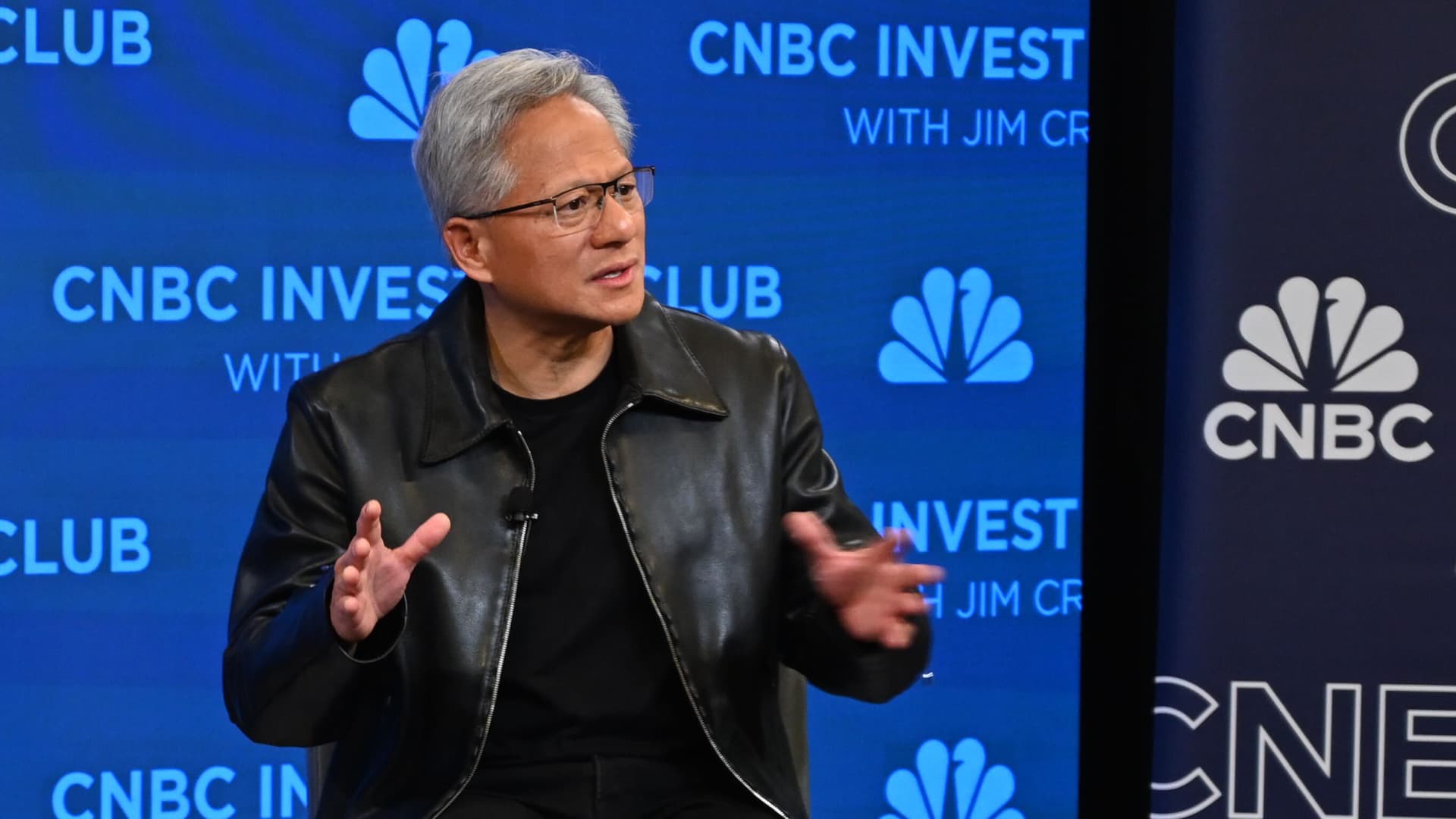
Remember Nvidia? I want to do the unthinkable: give you the rap on Nvidia spouted by the myriad short sellers who seem to want to break this company’s stock and its intellectual property abilities. It’s daunting and, to some degree, beleaguering even for me, its principal supporter in the media. It’s a brutal parade of horrors, so steel yourself, and — spoiler alert — I don’t believe any of these will derail the story of the company that is now valued at $4.4 trillion. The list includes a narrative that is negative, malevolent, anti-Jensen Huang, and, for the selfish purposes of yours truly, oppositional to the trust’s portfolio. Seatbelts on, please. Here are five critiques loved by the Nvidia bears and short sellers, and why I believe they are wrong. Bear case No. 1: Nvidia is no longer the king of AI chips. There are now several better challengers to Nvidia’s chips. Advanced Micro Devices claims that its most powerful chip, the MI450, is quite simply better and cheaper than Nvidia’s next-generation Vera Rubin. That’s why OpenAI announced its monster deal with AMD two weeks after Nvidia’s $100 billion deal, which is regarded as a lazy Susan deal — Nvidia gives OpenAI the money, and OpenAI gets the chips it needs. If Nvidia’s deal were so hot, the AMD hookup wouldn’t have been required. Plus, the AMD deal was done at the highest level by CFO Sarah Friar, and until she made her “backstop” comments about the federal government taking care of deals, she was the golden, grown-up executive in the process. The press has been brutal about this AMD deal, and it has spread much fear among the devoted. Amazon has developed its own chip, which it keeps improving to wean itself off Nvidia even as it proclaims itself a good friend and customer. Google has a chip that is so good that others are clamoring for it, including arch-enemy Meta, which is tired of paying Nvidia so much for its chips. Google’s chips are so good that they will force Nvidia to cut prices and destroy its margins, which is why its stock trades at about 25 times next year’s earnings. Google’s chips are a death star for Nvidia and Google, which can do no wrong in anyone’s eyes, to the point that we are going to have to engage with it (and perhaps Johnson & Johnson, but that’s for another column). Why it’s wrong: Analysts estimate that Nvidia controls between 70% and 95% of the AI chip market for training and deploying models like OpenAI’s GPT. That’s a pretty competitive moat. And for good reason: CEO Jensen Huang is the best there is, a true genius who puts out platforms filled with chips and software that dazzle and take AI and accelerated computing to a next level that can help you write software that can make everything faster and more accurate. Vera Rubin, Nvidia’s next-generation AI superchip platform, will help you “reason” much better than anything available, including the AMD chips. None of these competitive threats can measure up to Vera Rubin, and while not Tinkertoys, they can only be considered substitutes for dumber tasks. Bear case No. 2: Jensen is a cerebral good guy, not deeply enmeshed with the U.S. government. While Huang has been advocating for his company to be allowed to sell good, but not great, chips to China to prevent our rival from developing its own architecture, China went ahead and created a better product and no longer needs Nvidia. Why it’s wrong: Huang has been telling the same story since early last year, when the Trump Administration tightened Biden-era rules: Locking Nvidia out of the Chinese AI market on national security grounds will actually undermine U.S. tech leadership. That reasoning resonated with Trump, who began allowing sales of less-advanced chips to China over the summer and, this month, said Nvidia can ship its more advanced H200 AI chips to “approved customers” in China and elsewhere, so long as the U.S. gets a 25% cut. As I’ve said all along, Jensen is not just an engineer and architect — he’s also an incredible salesman and statesman. He knows how to tell the story. Bear case No. 3: Vera Rubin won’t be ready in time. Despite stories that indicate otherwise, this line refuses to go away. The idea is that if Vera Rubin isn’t on time — the company has said it will be by the second half of 2026 — customers will have to go elsewhere. The Vera Rubin platform, named for the famous astronomer who studied dark matter, will succeed Blackwell. Why it’s wrong: Jensen has a 20-year game plan that he thinks back from, not two years that he thinks forward to, so we should stop doubting and stay long. We have to stay long because, while there are plenty of threats to Nvidia’s dominance, they have never measured up: Nvidia designs and TSMC make better chips. Better chips equal better sales and better margins. The company’s dominance has constantly been threatened, which is how it became the largest company in the world. Bear case No. 4. Nvidia’s chips burn too hot and cannot be afforded. The chips require way too much power, power that can’t be had without multiyear build-outs that are impossible because the real source of power, the GE Vernova turbines, won’t be available til 2030. Quantum computing is right around the corner, which will allow other chips to sneak in and still be faster and cheaper. Why it’s wrong: The Information reported last month that Nvidia’s AI Blackwell chips overheat when connected to custom servers, and it had asked suppliers to change server rack designs several times. At the time, I said the subsequent drop in the stock price was a buying opportunity . CEO Jensen Huang has previously stated on CNBC that demand for the chips is “insane.” Despite so many errors, The Information is now the paper of record on the ills of Nvidia. There are no corrections of consequence in this new world, so a simple short-selling conjecture is too good to check out. So what if it is wrong? Bear case No. 5: OpenAI won’t get the money it needs. The maker of ChatGPT needs at least $100 billion fast, or Nvidia’s chips will sit in a warehouse and ding the company’s earnings. Why it’s wrong: If OpenAI gets the trillion-dollar valuation and the $100 billion it needs to give Oracle to get the data centers done, they will be filled with Nvidia chips, with some from AMD. It can be done. On Friday, I explained how the data center sector can regain its footing on the market once this happens. There is a mad scramble to get the Vera Rubin, while being tantalized by the Richard Feynman, an even further iteration scheduled for release in 2028. Oh yeah, no one has anything near that next-generation chip. NVDA YTD mountain Nvidia Year-to-date The only thing I left out is the threat of China exerting control over Taiwan, denying Nvidia access to the foundry TSMC , which it needs to produce chips. These stories are fed to the Street and gobbled up by the financial media. Beleaguered like I am? Why not just sell the stock and buy Alphabet? Just own that you are on the wrong horse, that it is sentimentality and ignorance that keep you in it. You would sell if you really knew what was going on, and your faith in Jensen stems from believing he’s a great man, but that’s in the past. You are a hack to stick with the man, or you don’t want to get him angry, and you are cut off. I know that my rationale seems fanciful. As I like to say, the long knives are out for Jensen and Nvidia, have been ever since the stock crossed the $2 trillion barrier and left behind other, so-called better, chips. In writing “How to Make Money in Any Market,” I talk about finding Nvidia when others didn’t know it. I now write about Nvidia even as others choose to believe reports from rivals that claim Nvidia has been beaten. When I first chose to believe in Nvidia, I was laughed at by everyone, including my colleagues. I now read the obituaries about Nvidia the same way I heard the prophecies of destruction when I talked about Nvidia as the best of the semis. The best of tech. The best of all companies on Earth. To which I say I am prepared to be wrong again. But I am not selling because I could have been wrong before. I chose to do nothing because I know Jensen and I know Nvidia, and I am not blinded by love; I am conscious of empirical data and excellent information. I guess you could say I am blinded by the facts. I willingly accept that form of blindness. And happily. (See here for a full list of the stocks in Jim Cramer’s Charitable Trust.) As a subscriber to the CNBC Investing Club with Jim Cramer, you will receive a trade alert before Jim makes a trade. Jim waits 45 minutes after sending a trade alert before buying or selling a stock in his charitable trust’s portfolio. If Jim has talked about a stock on CNBC TV, he waits 72 hours after issuing the trade alert before executing the trade. THE ABOVE INVESTING CLUB INFORMATION IS SUBJECT TO OUR TERMS AND CONDITIONS AND PRIVACY POLICY , TOGETHER WITH OUR DISCLAIMER . NO FIDUCIARY OBLIGATION OR DUTY EXISTS, OR IS CREATED, BY VIRTUE OF YOUR RECEIPT OF ANY INFORMATION PROVIDED IN CONNECTION WITH THE INVESTING CLUB. NO SPECIFIC OUTCOME OR PROFIT IS GUARANTEED.
