


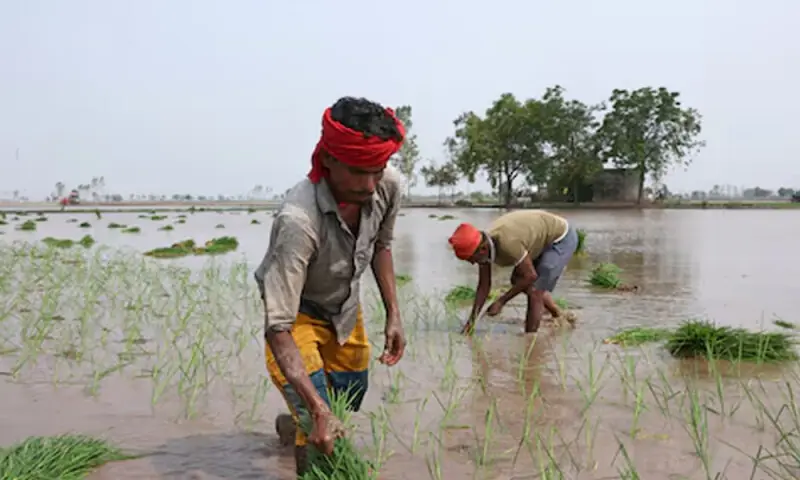
NEW DELHI: When India overtook China as the world’s largest producer of rice this year, the country’s politicians and agriculture lobby marked the moment by praising resilient farmers and innovative government policy.
India has nearly doubled the amount of rice it exported over the past decade, with shipments crossing 20 million metric tons in the latest fiscal year.
But many rice farmers in the country’s agricultural heartlands are in a less celebratory mood.
Interviews with growers, government officials and farm scientists, as well as a review of groundwater data, reveal widespread concern that thirsty rice crops are unsustainably draining India’s already-low aquifers, forcing farmers to borrow heavily to drill ever-deeper borewells.
In the rice-basket states of Haryana and Punjab, groundwater was reachable at around 30 feet a decade ago, according to 50 farmers and eight water and agriculture officials.
But drainage has accelerated in the past five years and borewells must now go between 80 and 200 feet, according to the farmers, whose accounts were corroborated with government data and research by Punjab Agricultural University.
“Every year, the borewell has to go deeper,” said Balkar Singh, a 50-year-old farmer in Haryana. “It’s getting too expensive.”
Pakistan rice exports plunge as Indian supply returns to global markets, experts say
At the same time, government subsidies that incentivize rice cultivation discourage farmers from switching to less water-intensive crops, said Uday Chandra, a South Asia politics expert at Georgetown University in Qatar.
The subsidies – some of them a legacy from past decades when India struggled to feed its growing population – include a state-guaranteed minimum price for rice that has climbed by around 70% over the past decade, as well as heavy power subsidies that encourage extracting water for farm use.
The net effect, said Avinash Kishore at the International Food Policy Research Institute think-tank in Washington, is that one of the world’s most water-stressed countries is paying farmers to consume vast amounts of precious groundwater.
The Indian Ministries of Agriculture and Farmers’ Welfare and of Water Resources did not respond when presented with Reuters’ findings.
Prime Minister Narendra Modi previously attempted to reform agricultural laws, including measures that would incentivize more private-sector crop purchases.
But that raised fears that the government might reduce the quantity of grain it purchases at guaranteed prices, prompting protests by millions of farmers that paralysed the nation five years ago and forced Modi into a rare retreat.
India accounts for 40% of the world’s rice exports, so any changes in production will have global implications, Kishore said.
In addition, India grows far more rice than it needs to feed its domestic population, which overtook China’s in 2023 to become the world’s largest, at more than 1.4 billion people.
“The sheer volume of rice India produces and exports gives it a pivotal role in global trade,” Kishore said. “But it also raises a question: should the country be growing and selling so much rice?”
Punishing extraction costs
While farmers in much of India rely on a mix of surface and groundwater irrigation, growers in the northern states of Punjab and Haryana, which are the nation’s leading rice producers, typically depend on groundwater.
That dependence makes rice farmers in both states particularly vulnerable to climate change, since aquifers aren’t fully recharged when monsoon rains are weak.
Even though monsoon rains have been strong for the last two years, farmers have been extracting so much water that aquifers in large parts of Haryana and Punjab are classified by the Indian government as either “over-exploited” or at “critical” levels.
Rupee gains prop up Indian rice rates as Thai, Vietnam prices slip
The two states extract between 35% and 57% more groundwater annually than their aquifers naturally replenish, according to government data for 2024 and 2025.
In an attempt to salvage the situation, local authorities in 2023 imposed bans on new borewells in critically exploited zones.
Growers constrained to existing borewells are in turn spending tens of thousands of rupees annually on equipment such as longer pipes and more powerful pumps that can extract from the dwindling supply, the farmers said.
Among them is Sukhwinder Singh, who farms a 35-acre plot in Punjab.
The 76-year-old, who is not related to Balkar Singh, said he spent between 30,000 rupees ($334.11) and 40,000 rupees last summer on equipment and labour that allowed him to continue growing rice despite the falling water table.
“If costs keep rising each season, it looks like they will soon become unsustainable,” he said.
Producing a single kilogram of rice consumes 3,000–4,000 litres of water, according to farm economist Ashok Gulati, who previously advised the government on crop prices. That is between 20% to 60% more than the global average, according to farm-policy experts.
Singh, the Punjab grower, said that farmers with larger plots like himself are still able to make a profit because they understand how to navigate government subsidies and can afford to drill deeper borewells.
That isn’t the case for subsistence growers, he said: “The falling water table is a major concern for all rice growers, but small farmers are hit hardest as every extra cost of cultivation dents their meagre income.”
Policy changes?
There are some signs that Indian officials are hoping to break the vicious cycle between rice subsidies and groundwater extraction.
The Haryana government last year began offering a subsidy of 17,500 rupees per hectare to encourage farmers to switch to crops such as millets, which require significantly less water. Millets, which are sometimes used as a substitute for rice, are gaining popularity in parts of urban India due to their perceived health benefits.
The incentive offered by the Haryana government to promote crops such as millets, however, is available only for one growing season and has so far failed to drive large-scale adoption.
The one-off incentive is too short, according to Gulati, who thinks at least five years are needed to encourage farmers to make a long-term switch from rice to millets.
The Haryana Department of Agriculture and Farmers’ Welfare did not respond to questions about the programme.
Gulati said his research indicates that the state could incentivize farmers to switch to less water-intensive crops without increasing spending on subsidies.
Punjab spends about 39,000 rupees on fertilizer and power subsidies for each hectare of rice grown, but redirecting 35,000 rupees to pay farmers who grow less thirsty crops would be enough to let them maintain their income levels, he said.
The government would also save by paring back on the amount of rice subsidies paid out, he said.
The Punjab Department of Agriculture did not return a request for comment on the impact of rice farming on the state’s water table.
Farmers would be willing to swap crops if properly incentivized, said Punjab rice grower Gurmeet Singh.
“The land of Punjab and Haryana is fertile and we as farmers are willing to switch … provided the government buys our produce at state support prices,” he said.
