


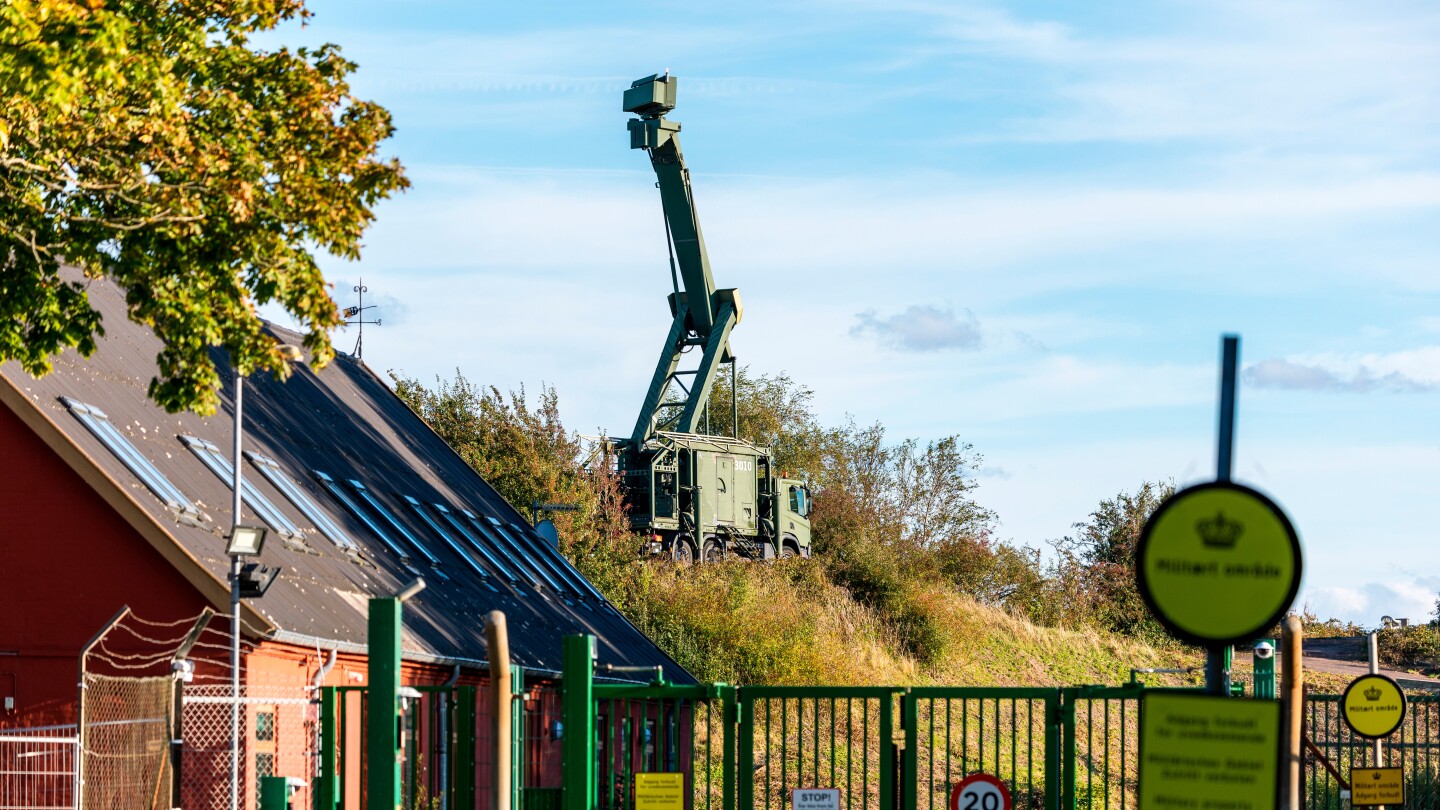
BRUSSELS (AP) — NATO is stepping up aerial surveillance in the Baltic Sea, while France, Germany and Sweden are bolstering Denmark’s air defenses ahead of two summits in Copenhagen this week over a series of troubling drone incidents near the country’s airports and military bases.
The number of serious airspace violations in Europe has spiked this month, including by Russian warplanes. But not all NATO allies agree on how to respond. Poland is ready to use lethal force. Others say that must only be a last resort.
Regardless of who is to blame in Denmark, European leaders believe that Russia is testing NATO. Military planners in Moscow can observe how Western forces react, and countering intrusions by relatively cheap drones is a financial burden on the allies.
In the wake of the drone incident in Poland, NATO launched operation Eastern Sentry, with Britain among the allies to send more air defense equipment.
However, these deployments might also deprive Ukraine of the air defense systems it badly needs from its allies. NATO must tread a tightrope in its response.
The use of lethal force
Poland’s message is blunt. It intends to shoot down intruders over its territory.
“If another missile or aircraft enters our space without permission, deliberately or by mistake, and gets shot down and the wreckage falls on NATO territory, please don’t come here to whine about it,” Polish Foreign Minister Radek Sikorski told Russia’s U.N. delegation last week. “You have been warned.”
Poland activated its air defenses over the weekend during a major Russian attack on Ukraine.
Defense is a national prerogative, even within the world’s biggest military alliance. Poland or Finland, say, might use force to defend their territory. U.S. President Donald Trump has agreed that European countries should be able to shoot intruders down.
The responsibility for that act would lie with the nation concerned. NATO, though, is likely to be more cautious in any joint operation using aircraft and equipment drawn from across the 32-country alliance.
“We have to act decisively and quickly,” NATO Secretary-General Mark Rutte said last week, but he underlined that it’s important to “always assess the threat levels” to see whether force is necessary.
NATO’s top military officer decides
NATO’s supreme commander in Europe, U.S. Gen. Alexus Grynkewich, manages airspace violations.
NATO’s rules of engagement are classified, but Grynkewich knows what arms and ammunition he has and what restrictions allies might place on their use. More than 30 air bases have aircraft on standby.
His choice would be based on intelligence about the threat posed. It would involve understanding the aircraft’s intent and weaponry, and the risk it — or a shootdown — might represent to NATO forces, civilians and infrastructure.
The response should also be proportionate. Spending millions of dollars to deter relatively cheap drones is not sustainable. Sometimes it’s best just to escort aircraft away, as NATO did when three Russian jets flew into Estonian airspace.
“Each airspace incursion puts NATO in a bind,” Rafael Loss from the European Council on Foreign Relations said in a security analysis.
“If they intercept (and potentially engage) the intruders, they risk providing Russia with valuable insights about NATO’s reaction times and engagement procedures. If they ignore them, it risks inviting ever-escalating Russian violations of allied airspace,” he said.
Pressure on pilots
Retired French Navy Capt. Pierre-Henri Chuet, who flew Super Étendard and Rafale fighter jets for the French Navy, said the stress on pilots increases the risk of miscalculation and even actual confrontation.
“Pilots are going to have to be very careful. And the chain of command is going to have to be extra careful on the ways they brief pilots to know what is a hostile act, what is a hostile intent, what is an aggression, and what isn’t,” Chuet said in an Associated Press phone interview.
“Opening fire is really, really, really, really the last resort,” he said.
The price of miscalculation
An overreaction could incur even greater costs. Russia’s ambassador to France, Alexei Meshkov, has already warned that downing a Russian aircraft would trigger a war, and NATO does not want to be dragged into conflict with a nuclear armed adversary.
Already in 2015, Russia and NATO ally Turkey came to the brink of open conflict after a Turkish F-16 shot down a Russian bomber near the Syrian border, killing its pilot. Russia retaliated with sanctions.
In 1983, a Korean Airlines flight was shot down with an air-to-air missile after veering into Soviet airspace, killing all 269 people on board. It caused a major spike in tensions between the Soviet Union and the West.
The value of deterrence
Ultimately, NATO’s ability to prevent airspace violations rests on the strength of its deterrent effect: not just its military might but also the political will to use the weapons at its disposal.
Right now, though, U.S. leadership appears reticent. Coincidentally or not, the serious airspace violations have happened since Trump’s summit with President Vladimir Putin in Alaska in August, when the U.S. leader dropped his demand for a ceasefire in Ukraine.
In response to the drone incident in Poland, Trump said that it “could have been a mistake.” Last week he said the U.S. would “continue to supply weapons to NATO for NATO to do what they want with them,” almost as if America were not a member.
And so far, the United States has not sent military equipment to help counter the airspace violations.
“Through these successive incursions, Putin has shown he is undeterred. After all, by flaunting mischief at low cost, Putin aims to leave Europeans — lacking resolute American backing — with only bad options,” Loss said.
___
AP Writer John Leicester in Paris contributed to this report.
