


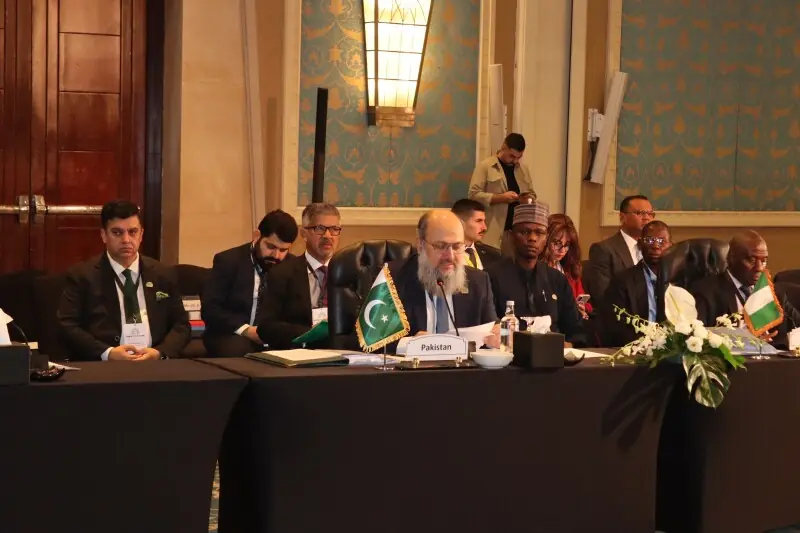
Pakistan has called for the full operationalisation of the D-8 Preferential Trade Agreement (PTA), with Commerce Minister Jam Kamal Khan urging member states to remove procedural hurdles and accelerate efforts to expand intra-D8 trade.
Federal Minister for Commerce, Jam Kamal Khan, made the remarks during the Fourth Meeting of the D-8 Trade Ministers Council held in Cairo, underscoring the central role of the D-8 PTA as a catalyst for expanding intra-D8 trade, calling its effective implementation “essential for realising its full benefits.”
He emphasised Pakistan’s commitment to harmonising procedures, resolving operational challenges, and streamlining documentation to make the PTA fully functional and impactful for all members.
D-8, or the Developing-8 Organization for Economic Cooperation, is an organisation of eight developing countries that aims to improve economic and trade cooperation among its members. The member countries are Bangladesh, Egypt, Indonesia, Iran, Malaysia, Nigeria, Pakistan, and Türkiye.
At the session, the Federal Minister for Commerce signed the D-8 Protocol on Dispute Settlement Mechanism, marking an important step toward the institutional strengthening of the organisation. The signing of the protocol—together with the operationalisation of the PTA among D-8 member states—is expected to further enhance trade, facilitate smoother economic engagement, and support the long-term vision of a more integrated D-8 economic bloc.
Highlighting the rapidly evolving global economic environment, Jam Kamal stressed the urgency for regional platforms like the D-8 to respond collectively to rising protectionism, supply chain disruptions, climate-related shocks, and commodity market volatility. Strengthened cooperation, he noted, is essential to maintain resilience, sustain trade flows, and foster market confidence.
Pakistan for greater D-8 role to get Israeli aggression ended
He further highlighted the need for stronger institutional linkages in customs, standardisation, mutual recognition, and logistics connectivity, stressing that efficient transport corridors, digital integration, and predictable transit systems were critical to unlocking regional trade potential. Pakistan, he said, stands ready to contribute constructively to these efforts.
Jam placed strong emphasis on private-sector engagement, encouraging deeper B2B cooperation, joint ventures, technology sharing, and sectoral partnerships where D-8 economies complement each other. He underscored the importance of creating an enabling environment supported by policy stability, information access, and financial facilitation.
On sustainable development, the minister noted that economic progress must be aligned with environmental responsibility and social inclusion. He added that the D-8, through capacity-building and best-practice sharing, has the potential to become a model for South-South cooperation.
Recognising the rapid expansion of digital trade and technology-driven services, the minister urged member states to invest in digital infrastructure, digital literacy, and cross-border e-commerce platforms. Pakistan, he said, is eager to work with D-8 partners on fintech, digital payments, and innovation-led initiatives.
Jam expressed confidence that the Council’s deliberations would be constructive and future-oriented. He reaffirmed Pakistan’s full commitment to advancing the D-8’s agenda for shared prosperity and regional integration.
