
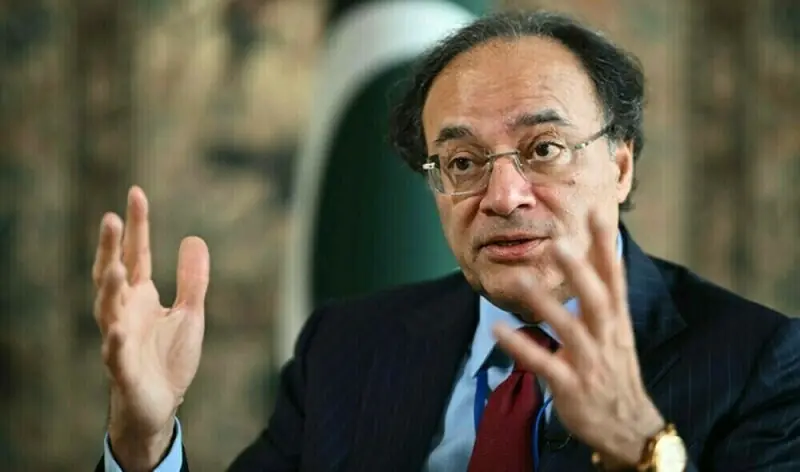
Federal Minister for Finance Muhammad Aurangzeb has stated that Pakistan’s Free Trade Agreement talks with the Gulf Cooperation Council (GCC) countries are in advanced stages, signalling a potential boost to trade and investment.
“We are overall moving forward with the FTA, overall with GCC,” said Aurangzeb, in an interview with CNN Business Arabia
“I think in terms of timing, we are very close.
“It’s my colleagues on the commerce side who are leading, so they would have the exact timeframe. But I do think we are relatively close,” he said.
During the interview, the finance minister underscored that the strategic shift reflects Pakistan’s renewed economic confidence and reform momentum, read a statement released on Monday.
GCC-Pakistan FTA in final stages: PM
Aurangzeb acknowledged the longstanding support of GCC countries, including Saudi Arabia, the United Arab Emirates, and Qatar, noting their critical role in supporting Pakistan through financing, funding, and cooperation at international financial institutions such as the International Monetary Fund (IMF).
“But all of this is now meant to move towards more trade and investment,” he said.
IMF reforms for Pakistan are not new conditions, says Ministry of Finance
He shared that remittances continue to play a vital role in supporting the current account, with inflows reaching approximately $38 billion last year and projected to rise to $41-42 billion this year, over half of which originates from GCC countries.
“We should now move towards more trade and investments in sectors like energy, oil and gas, minerals and mining, AI, digital infrastructure, pharma, and agriculture. So these are all sectors with which we are now very actively working with our GCC partners to secure investments into Pakistan,” shared the minister.
During the interview, the finance minister highlighted that over the past 18 months, Pakistan has remained on a comprehensive macroeconomic stabilisation program, which has delivered tangible and measurable results.
“Inflation is now in the single digits. We have a primary surplus on the fiscal side, while the current account deficit is very much in control and in line with the target,” Aurangzeb said.
He further noted that the exchange rate has stabilised and foreign exchange reserves have improved to approximately 2.5 months of import cover, reflecting strengthening external buffers.
Aurangzeb pointed to two major external validations of Pakistan’s improving economic outlook.
“Firstly, all three international credit rating agencies have aligned their assessments this year by upgrading Pakistan’s ratings and outlook.
“Secondly, Pakistan has completed the second review under the IMF Extended Fund Facility, with the IMF Executive Board granting its approval earlier this week”, said Aurangzeb.
These developments, he said, demonstrate growing international confidence in Pakistan’s economic management and reform trajectory.
The minister shared that reforms are being implemented across key areas, including taxation, energy, state-owned enterprises, public financial management, and privatisation, aimed at consolidating stability and laying the foundation for sustainable growth.
On taxation, Aurangzeb noted significant progress in improving Pakistan’s tax-to-GDP ratio, which stood at 8.8% at the start of the reform program. “During the course of last fiscal year, we have hit 10.3%, and we are moving towards 11%,” he said.
He explained that the government’s objective is to reach a level of tax collection that ensures “fiscal sustainability” over the medium to long term.
In the energy sector, the finance minister highlighted efforts to improve governance in distribution companies, involve private sector expertise, advance privatisation, and reduce circular debt, which has long constrained the power sector.
He stressed that rationalising the tariff regime is essential to making energy more competitive for industry, thereby enabling industrial revival and economic growth.
Reiterating the government’s strategic direction, Aurangzeb said that Pakistan’s future lies in fostering trade and investment partnerships rather than reliance on aid. “We are not looking for aid flows anymore,” he said.
