


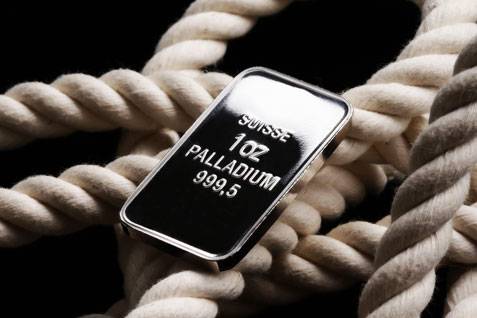
Palladium prices declined during Friday’s trading, attempting to pause after technical buying that lifted most precious metals, including silver, which recently reached record levels, amid ongoing uncertainty over US Federal Reserve policy.
Daily price movements in palladium are influenced by the same factors that guide overall performance across the precious metals complex, most notably US interest rate expectations, the strength of the dollar, and investor risk appetite.
These developments carry particular importance because palladium, like gold and silver, is globally priced. When expectations tilt toward interest rate cuts or a weaker dollar, non-yielding assets typically benefit, while heightened economic data risks can prompt short-term risk-reduction moves in metals markets.
Reuters also highlighted that delays or gaps in US economic data collection, resulting from the US government shutdown, add further complexity to the economic outlook and introduce an additional layer of uncertainty for traders when positioning their investments.
Key demand headline for palladium: Europe rethinks internal combustion engines by 2035
One of the most significant new catalysts shaping the medium-term demand narrative for palladium emerged on December 16, amid signals that the European Commission may soften its stance on banning new internal combustion engine vehicles by 2035.
Reuters reported that the European Commission is preparing to roll back the current plan by allowing the continued sale of some vehicles that are not fully electric, under strong pressure from major member states and the automotive industry. Under the proposal cited by the agency, the emissions reduction target would be revised from a 100% cut to 90% by 2035 compared with 2021 levels, potentially extending the lifespan of plug-in hybrids and range-extender vehicles.
In a separate report, Reuters noted that the European Commission is also considering a compensation mechanism that could allow internal combustion engine vehicles to continue being sold after 2035, through measures that include alternative fuels and accounting for green steel.
Why does this policy shift matter for palladium price expectations?
Palladium is closely tied to internal combustion engines due to its use in catalytic converters that reduce harmful emissions in gasoline engines. As a result, extending the life of hybrid vehicles and internal combustion engines in Europe — if legally approved — could slow the erosion of palladium’s core demand base.
Reuters quoted a commodities strategist at WisdomTree as saying that this policy shift is “likely to be supportive for internal combustion engine vehicles,” which rely on platinum and palladium.
In short, even modest adjustments to the expected timeline for the decline of internal combustion engines can feed through to palladium’s future demand curve, influencing speculative positioning and longer-term price expectations.
Supply and balance: the concept of “deficit” changes depending on investment demand
Alongside demand developments, the palladium market is also responding to supply-demand balance signals, particularly those issued by Russia’s Norilsk Nickel (Nornickel), the world’s largest palladium producer.
According to a December 16 analytical note published by FXStreet, citing Commerzbank commodities analyst Carsten Fritsch, Nornickel’s updated outlook can be summarized as follows:
For 2025, Nornickel expects the palladium market to be balanced when investment demand is excluded, but to show a deficit of about 200,000 ounces when investment demand is included.
For 2026, excluding investment demand, the company expects a deficit of 100,000 ounces.
Mining.com, citing Reuters reports, reaffirmed the same figures: balance in 2025 without investment demand, a 200,000-ounce deficit when it is included, and a 100,000-ounce deficit in 2026 excluding investment activity.
Investor takeaway
When reading headlines about a “deficit in the palladium market,” attention should be paid to the fine print: does the deficit include investment demand or not?
In a small and concentrated market like palladium, shifts in ETF flows or physical investment demand can materially alter the supply-demand balance — and, in turn, price sentiment.
This investment dimension was also highlighted in broader commentary on precious metals. A daily report from the India Bullion and Jewellers Association dated December 16 noted that palladium has risen by about 25% since the start of the rally, alongside strong gains in silver and platinum, illustrating how momentum has rotated from gold into the wider precious metals complex.
Outlook and forward view: where is palladium headed in 2026?
Strong palladium gains during 2025 have prompted analysts to reassess scenarios for 2026. The market currently stands at the intersection of two competing narratives:
Structural support factors include tight supply, concentrated production, and political developments that could extend demand for internal combustion engines and hybrid vehicles.
Structural headwinds include the long-term shift toward fully electric vehicles and substitution risks, which may cap upside for a metal heavily dependent on gasoline exhaust catalysts.
The most widely cited forecasts as of mid-December 2025 include:
Morgan Stanley expects palladium prices to reach $1,325 per ounce in 2026, alongside higher forecasts for platinum, driven by structural imbalances and divergent demand drivers.
Heraeus Precious Metals projected a wide 2026 palladium price range between $950 and $1,500 per ounce in a December 8, 2025 report, warning of a potential expansion in surplus if demand for catalytic converters weakens as electric vehicle penetration rises.
The World Platinum Investment Council expects a slight deficit in the palladium market during 2025, followed by a shift to a modest surplus in 2026 under its base-case scenario.
A Reuters survey showed the average 2026 forecast at $1,262.50 per ounce, up from $1,100 in the previous survey, reflecting a change in sentiment after the strong 2025 rally.
During US trading hours on Friday, March palladium futures were down 0.4% at $1,768 per ounce as of 14:34 GMT.
