


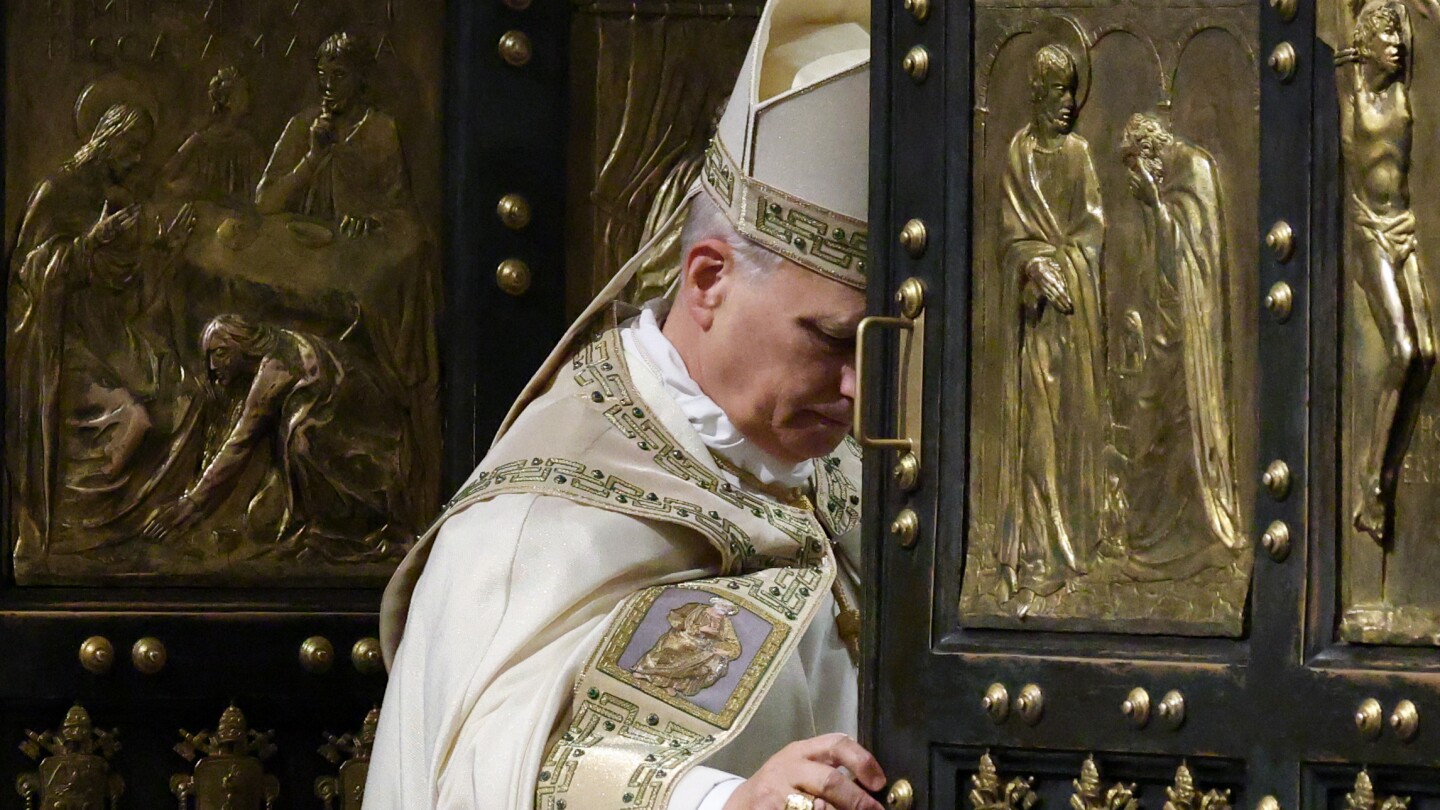
VATICAN CITY (AP) — Pope Leo XIV on Tuesday closed out the Vatican’s 2025 Holy Year, capping a yearlong celebration of Christianity that saw some 33 million pilgrims flock to Rome and a historic papal transition from one American pope to another.
With cardinals and diplomats looking on, Leo kneeled down in prayer on the stone floor at the threshold of the Holy Door of St. Peter’s Basilica. He then stood up and pulled the two doors shut, symbolically completing the rarest of Jubilees: one that was opened by a feeble Pope Francis in December 2024, continued during his funeral and the conclave, and then was closed by Francis’ successor a year later.
Only once before, in 1700, has a Holy Year been opened by one pope and closed by another.
Tuesday’s ceremony, at the start of Mass celebrating the feast of Epiphany, capped a dizzying year of special audiences, Masses and meetings that dominated Leo’s first months as pontiff and in many ways put his own agenda on hold.
As if to signal his pontificate now can begin in earnest, Leo has summoned the world’s cardinals to the Vatican for two days of meetings starting Wednesday to discuss governing the 1.4-billion strong Catholic Church. On the agenda is the issue of the liturgy, suggesting Leo is diving head-first into the divisions within the church over the celebration of the old Latin Mass.
For the Vatican, a Holy Year is a centuries-old tradition of the faithful making pilgrimages to Rome every 25 years to visit the tombs of Saints Peter and Paul and receive indulgences for the forgiveness of their sins if they pass through the Holy Door.
For Rome, it’s a chance to take advantage of public funds, in this case some 4 billion euros ($4.3 billion), to carry out long-delayed projects to lift the city out of years of neglect and bring it up to modern, European standards.
The Vatican on Monday claimed 33,475,369 pilgrims had participated in the Jubilee, but the Vatican’s Holy Year organizer, Archbishop Rino Fisichella, acknowledged the number was only a rough estimate and could include double counting. At a press conference, neither he nor Italian officials provided a breakdown between Holy Year pilgrims and Rome’s overall tourist figures for the same period.
A history of Jubilees
Rome’s relationship with Jubilees dates to 1300, when Pope Boniface VIII inaugurated the first Holy Year in what historians say marked the definitive designation of Rome as the center of Christianity. Even then, the number of pilgrims was so significant that Dante referred to them in his “Inferno.”
Massive public works projects have long accompanied Holy Years, including the creation of the Sistine Chapel (commissioned by Pope Sixtus IV for the Jubilee of 1475) and the big Vatican garage (for the 2000 Jubilee under St. John Paul II).
Some works have been controversial, such as the construction of Via della Conciliazione, the broad boulevard leading to St. Peter’s Square. An entire neighborhood was razed to make it for the 1950 Jubilee.
The main public works project for the 2025 Jubilee was an extension of that boulevard: A pedestrian piazza along the Tiber linking Via della Conciliazione to the nearby Castel St. Angelo, with the major road that had separated them diverted to an underground tunnel.
Leo has already announced that the next Jubilee will be in 2033, to commemorate what Christians believe was the A.D. 33 death and resurrection of Christ.
___
Associated Press religion coverage receives support through the AP’s collaboration with The Conversation US, with funding from Lilly Endowment Inc. The AP is solely responsible for this content.
