
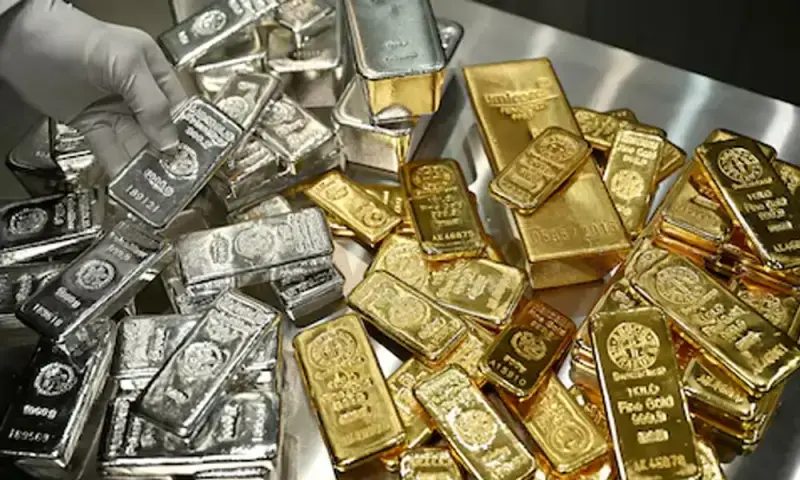
Silver outperformed gold in Pakistan’s precious metals market in 2025, with prices surging and the white metal recording gains nearly twice as high as gold.
Silver closed the 2025’s last trading session at Rs7,718 per tola in Pakistan, up by massive 130% against Rs3,350 per tola it had closed at on December 31, 2024, according to the rates shared by the All-Pakistan Gems and Jewellers Sarafa Association (APGJSA).
Meanwhile, gold gave 68% return to investors in Pakistan, closing the calendar year at Rs456,962 per tola, against Rs272,600 per tola at the end of 2024 – a 68% increase in 2025.
Read more: Silver shines in 2025 global market spotlight as softs, oil lag
“There was strong demand for both silver and gold throughout the year,” said Abdullah Abdul Razzak Chand, President of the Society Welfare Jewellers Association in Karachi.
“Silver saw an extraordinary yearly increase, as the white metal remained in demand in demand in the international markets.
“The use of silver has increased significantly in recent years, driven primarily by strong industrial demand in green energy, electronics, etc.
“The latest solid-state battery technology that incorporates a silver-carbon (Ag-C) composite layer for the anode has also increased silver demand,” Chand said.
Silver has drawn additional support from its designation as a critical US mineral, ongoing supply constraints and low inventories, while sustained central bank buying has supported gold.
In the international markets, precious metals were the standout performers among commodities this year, with silver outperforming most major equity indexes and currencies, while gold hit record highs on economic and geopolitical risks. Silver gained 161% in 2025, breaking the $80 per ounce mark for the first time, while gold climbed 66%.
The US officially added silver to its list of critical minerals in 2025, putting further demand pressure on a metal already in short supply. It also increased the possibility of tariffs on silver.
The US Geological Survey (USGS) critical mineral list was established in 2017, and it guides federal strategy, investment, and mine permitting decisions.
Last week, China named the companies that will be able to export tungsten, antimony and silver during the 2026 and 2027 period, metals Beijing deems as critical to support its own industries.
Also read: FY25: gold shines with robust 45% return in Pakistan
A total of 44 companies will be allowed to export silver, while the numbers for tungsten and antimony will be 15 and 11 respectively, China’s Ministry of Commerce said in a statement. That’s two more than in 2025 for silver, while tungsten and antimony are unchanged.
Precious metals have room for greater gains in 2026 as interest rates are expected to fall, but agricultural and energy products offer little cheer as growing supplies and tepid demand curb any upside potential, Reuters recently reported citing analysts.
