
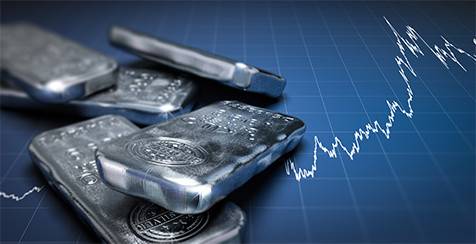
Silver has long played a secondary role to gold — but in 2025, it has begun challenging it for the spotlight. Often dubbed “the poor man’s gold,” silver offers both an inflation hedge and exposure to industrial growth, giving it a uniquely dual appeal.
This year, the white metal has staged an exceptional rally. Prices surged to their highest levels in years, breaking multiple records. Silver surpassed its historic peak of $48.70 per ounce from April 2011, reaching $54.08 per ounce on October 17, 2025, in global markets. In India, spot prices climbed to a record ₹1,76,304 on October 14, 2025. October 2025 will be remembered as a watershed month for silver — not only did it hit a new all-time high, it also delivered its strongest monthly return ever.
The performance is striking: year-to-date returns exceed 70%, outpacing every major asset class, including equities, gold, and commodities.
Kineta Chhainwala, Assistant Vice President for commodity research at Kotak Securities, said silver’s outperformance was driven by a blend of safe-haven demand, a weaker dollar, lower interest rates, and strong industrial usage.
She added that silver lease rates have risen after the metal was included in the US list of critical minerals — a sign of tightening physical supply. Lease rates represent the annual cost of borrowing silver in the London bullion market; higher rates indicate scarcity.
Rise of silver ETFs
Traditionally, demand for gold and silver rises ahead of festivals such as Dhanteras and Diwali. With rising geopolitical tensions and global uncertainty, investors have been shifting more aggressively toward precious metals.
The sharp rise in silver prices relative to gold — combined with festive-season demand — triggered massive inflows into silver exchange-traded funds (ETFs), leading to shortages and causing these ETFs to trade at steep premiums over the underlying metal. The imbalance forced fund houses to temporarily halt new subscriptions to protect investors and restore stability.
Unlike gold ETFs, which have existed in India for over 20 years, silver ETFs are relatively new. SEBI approved them only in September 2021, with the first launches arriving in 2022 through ICICI Prudential.
In just a few years, interest skyrocketed. Assets under management jumped from ₹2,844.76 crore in October 2023 to ₹12,331 crore in October 2024 — and then to more than ₹37,518 crore by September 2025, more than tripling in a single year.
Data shows silver ETFs delivered a three-year average return of 39.14%, compared with 34.86% for gold ETFs.
In September 2025 alone, monthly inflows hit ₹5,342 crore — 28% of all passive-fund inflows — while gold ETFs attracted ₹8,363 crore. Combined, gold and silver accounted for about 72% of total flows, reflecting investors’ growing reliance on precious metals to diversify portfolios amid global instability.
With the advent of silver ETFs, participation has become far easier for retail investors compared with physical buying or futures trading.
Why is silver shining?
A supply-demand imbalance
The core reason behind silver’s surge is a persistent supply deficit. Global supply has lagged demand for five straight years, according to the Silver Institute. Another deficit is anticipated in 2025 amid weak mine output and lower recycling.
Supply is projected at around 1.03 billion ounces in 2025 versus demand of 1.148 billion ounces. Over five years, demand has exceeded supply by roughly 800 million ounces, with a fresh deficit of about 187 million ounces expected this year.
Because much of global silver output is a by-product of mining other metals, supply is slow to respond even when prices rise.
Industrial demand boom
Explosive growth in clean-energy industries has created immense demand pressure. Solar panels are the single largest consumer of silver, followed by electric vehicles, electronics, 5G components, and semiconductors.
Industrial demand is estimated at 680 million ounces in 2025 — more than half of global consumption.
The new safe haven
Beyond industrial strength, inflation pressures, geopolitical crises, and weak economic outlooks have lifted investment demand for silver. Global silver ETF holdings have risen to 0.82 billion ounces — the highest level since July 2022.
A century of dramatic cycles
Over the past century, silver has experienced long stretches of stagnation punctuated by dramatic spikes. It traded at $0.69 per ounce in 1925, crossed $1 only in 1962, doubled by 1967, and soared during the inflationary 1970s to reach $35.52 in 1980 during the infamous Hunt Brothers squeeze.
Prices then collapsed to $5 by 1982 and remained subdued until the post-2008 rally, which sent silver to $48.20 in 2011. It broke that level once again in 2025.
Will the rally continue?
Despite powerful momentum, analysts warn of volatility. They attribute the current surge to China’s shift toward clean energy, the disruption at Indonesia’s Grasberg mine, strong ETF inflows, and robust Asian demand.
Demand is expected to remain strong thanks to solar-energy expansion and EV adoption, while supply remains constrained by underinvestment in new mining projects.
Reports such as Motilal Oswal’s “Unprecedented Silver Market Boom 2030” argue the metal is in the early stages of a long structural bull market.
What should investors do?
Silver can be an effective tool for portfolio diversification and inflation hedging, with potential to outperform gold during economic recoveries.
Experts caution against chasing short-term buying frenzies and instead advise using silver as a strategic asset offering both industrial upside and inflation protection.
If your portfolio allocates around 15% to precious metals, a 50-50 split between gold and silver may reduce volatility while maximizing the complementary strengths of both metals.
