
After months of operating in the dark, markets finally received some inflation data last week. The long-delayed November Consumer Price Index offered an official glimpse into day-to-day price pressures after a record-length government shutdown had disrupted the economic calendar.
The figures themselves were better than expected. Headline inflation came in at 2.7% year on year, while core inflation registered 2.6%. That was below the near-3% readings economists had been bracing for, and it kept inflation within the psychologically important “two-handle” range that markets have become fixated on heading into 2026.
At the same time, the report was far from ideal or “clean.” Because the US Bureau of Labor Statistics was unable to collect October price data during the shutdown, the release lacked the usual month-to-month changes that analysts rely on to gauge momentum. Instead, it resembled a sharp snapshot — confirmation of where inflation currently stands rather than a clear signal of where it is heading next.
That distinction matters. And not just for interest rates.
When inflation becomes a question about America itself
In 2025, inflation stopped being merely a story about prices. Instead, it became part of a broader question markets were asking about the United States itself — namely, whether US assets still deserve the “premium” they have enjoyed for more than a decade, across everything from equities and bonds to the dollar itself.
On that front, the details of the CPI report offered little reassurance. Prices for furniture and “household operations” — a broad category covering everything from cups and cutlery to shovels and lawn trimmers — continued to rise as companies began passing through higher import costs linked to tariffs. Food inflation also remained stubborn, with meat, poultry, and egg prices up about 5% over the past year. Housing costs continued to climb as well, with shelter prices rising roughly 3% year on year.
This mix has become familiar: uneven goods inflation, tariffs quietly doing their work in the background, and persistently elevated rents and housing costs. Federal Reserve Chair Jerome Powell has repeatedly pointed to trade policy as one reason inflation has exceeded expectations, while also stressing that officials need clearer evidence before concluding whether price pressures reflect a one-off adjustment or something more durable. For currency markets, that ambiguity carries real consequences.
Why inflation matters for the dollar even when it is falling
Currency markets are not always sensitive to inflation itself. What matters is what inflation signals — about growth, policy, credibility, governance, and, perhaps above all, predictability.
Over the past decade, the United States was able to tolerate higher inflation without its currency being punished. During the pandemic, for example, the dollar initially surged as a safe haven and then remained unusually strong for years as the US economy outperformed its peers and led the global rate-hiking cycle. Stronger growth, higher yields, deep capital markets, and institutional stability — as long as that mix held together, the dollar premium remained intact.
In 2025, that mix began to fray.
Even as inflation eased, it did so amid tariff-driven distortions, political pressure on the Federal Reserve, and months of missing data that made the economic picture harder to read. Investors were no longer asking only whether prices were falling quickly enough; they were questioning whether the rules of the game themselves were changing.
That reassessment defined the dollar’s year.
Why 2025 may be remembered as the year the world blinked at the dollar
At the start of January, the dollar entered the year near its recent historic highs, supported by a decade-long rally. Then the tide turned.
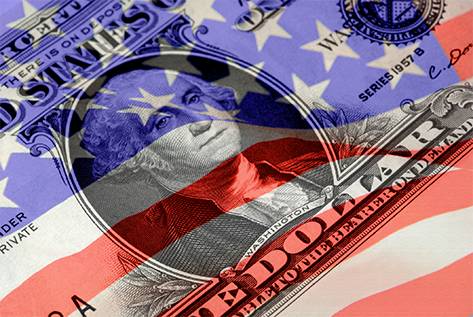
From January through June, the dollar fell about 11% against a basket of major currencies — its worst first-half performance since the early 1970s, when the collapse of the Bretton Woods system and the oil crisis upended the global order.
What changed had less to do with monetary policy and more to do with expectations. After the 2024 election, markets largely assumed another phase of US outperformance, supported by capital inflows, resilient American consumers, and a politically independent Federal Reserve. That narrative cracked in the spring, when fresh tariff announcements and broader uncertainty forced investors to rethink growth, inflation, and public debt all at once.
Crucially, the dollar weakened even as the Federal Reserve resisted signaling imminent rate cuts. Instead, markets began pricing a different story: slower US growth, eroding governance advantages, and a loss of clarity. Once investors stopped believing the United States was unambiguously dominant, the dollar’s yield premium stopped doing the same work.
Capital flows followed. Foreign investors hold more than $30 trillion in US assets, much of it historically unhedged against currency risk — an implicit bet on a strong dollar. As the currency slid in early 2025, those same investors began adding currency hedges, effectively selling dollars into the market. Given the scale of foreign ownership of US assets, even small shifts in hedging behavior can generate meaningful pressure.
A floor without a rebound
By mid-year, the dollar’s decline had stabilized. Some stronger-than-expected economic data in July, along with signs that tariffs were not hitting activity as hard as feared, helped steady sentiment. But stabilization is not recovery.
For most of the second half of 2025, the dollar hovered near its lows, moving sideways without a convincing rebound. That behavior itself is telling. The initial repricing of US dominance may be complete, but the old premium has not been restored — artificial-intelligence equities notwithstanding.
Then came Thursday’s inflation report.
Had the CPI data delivered a clean, decisive disinflationary trend, it might have provided a catalyst — reinforcing the idea that inflation risks were fading, that the Federal Reserve could ease policy with confidence, and that US outperformance was reasserting itself. Instead, markets received only a partial signal. Inflation is easing, but unevenly; tariffs are still pushing prices higher; uncertainty remains elevated. For currency markets that prize clarity, that was not enough to alter the prevailing dynamic.
Is the dollar “finished” in 2026?
That is the wrong question. The better one is whether markets will complete the recalibration that began in 2025 — or decide that the United States remains, for better or worse, the least risky place in the world.
Some strategists, including those at Morgan Stanley, expect further dollar weakness as US growth slows, interest-rate differentials narrow, and foreign investors continue to hedge. Others argue that the downturn implied by recent consumer-confidence surveys could, paradoxically, trigger a renewed “flight to safety” that supports the US dollar.
Both outcomes are plausible. What seems less likely is a swift return to the effortless dollar dominance that characterized much of the 2010s.
What this means for all of us
Currency moves are among the most abstract forces in markets — a haze of decimals and charts. Until, of course, they show up in real life. A weaker dollar means more expensive foreign travel, costlier imports — champagne, handbags, those nice French shoes I keep eyeing online — and fewer bargains overall. For most households, it is a slow accumulation of costs that makes life feel just a bit more expensive.
The real story is not the dollar’s 11% decline. It is what caused it. For the first time in a long while, investors around the world are pricing the possibility that “American exceptionalism” may come with an expiration date.
Whether they are right or wrong, that shift in expectations looks to me like the most consequential repricing of 2025.
