


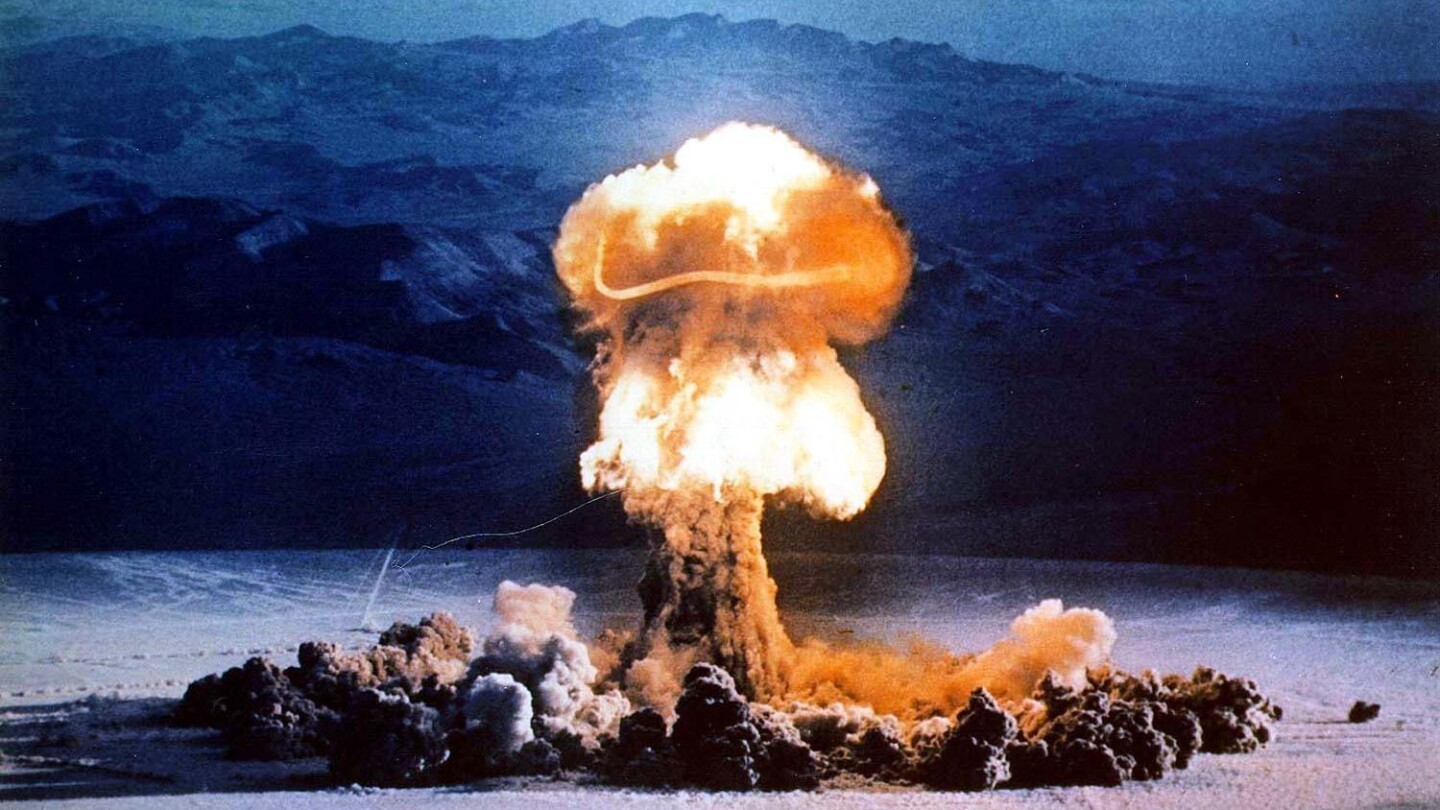
VIENNA (AP) — In the wake of U.S. President Donald Trump’s suggestion earlier this year that the U.S. would resume nuclear testing, a U.S. government representative defended the stance at a global nuclear arms control meeting and pointed to nuclear provocations from Russia, China and North Korea.
U.S. Chargé d’Affaires to the International Organizations in Vienna Howard Solomon made the previously unpublished comments, which were obtained by The Associated Press, at the Preparatory Commission of the Vienna-based Comprehensive Nuclear-Test-Ban Treaty Organization on Nov. 10.
“As President Trump indicated, the United States will begin testing activities on an equal basis with other nuclear-armed states. This process will begin immediately and proceed in a manner fully consistent with our commitment to transparency and national security,” Solomon said.
Solomon provided further explanation by noting, “For any who question this decision, context is important. Since 2019, including in this forum, the United States has raised concerns that Russia and China have not adhered to the zero-yield nuclear test moratorium,” he said, adding that the concerns “remain valid.”
Solomon’s comment referred to so-called supercritical nuclear test explosions banned under the Comprehensive Nuclear-Test-Ban Treaty, known as CTBT, where fissile material is compressed to start a self-sustaining nuclear chain reaction that creates an explosion.
Stay up to date with the news and the best of AP by following our WhatsApp channel.
Follow on

The explosive tests produce an amount of energy released, referred to as nuclear yield, which defines a weapon’s destructive power. The treaty bans any nuclear explosion with a yield, even a very small one, following a zero-yield standard.
“Our concerns with Russia and China are in addition to the activities of North Korea, which has conducted six nuclear explosive tests this century,” Solomon said.
The global monitoring network established alongside the treaty in 1996 to register nuclear tests worldwide has detected all of North Korea’s six nuclear tests this century. Those were tests with larger yields.
However, the monitoring network is unable to detect very low-yield supercritical nuclear tests conducted underground in metal chambers, experts say.
The U.S. State Department did not immediately reply to a request for comment on whether Solomon was referring to low-yield supercritical nuclear tests.
US says Russia and China are testing
China and Russia, which have signed but not ratified the treaty, say they adhere to a nuclear testing moratorium.
But since 2019, the U.S. State Department has publicly expressed concerns about China and Russia not adhering to their zero-yield testing moratoria. Annual reports on compliance with arms control agreements to the U.S. Congress cite possible activities at the Lop Nur nuclear testing site in the Xinjiang region of northwestern China and Russia’s Novaya Zemlya site, a remote Arctic archipelago.
In an interview for “60 Minutes” that aired Nov. 2 on CBS News, Trump said, “Russia’s testing, and China’s testing, but they don’t talk about it. You know, we’re a open society. We’re different. We talk about it.”
“They don’t go and tell you about it,” Trump continued. “You know, as powerful as they are, this is a big world. You don’t necessarily know where they’re testing. They — they test way under — underground where people don’t know exactly what’s happening with the test.”
A White House official, asked for comment on whether Trump was referring to low-yield supercritical nuclear tests conducted underground, said the president had directed tests be done “on an equal basis” to other countries. The official spoke on condition of anonymity because they were not authorized to speak on the record about the testing plans.
Other countries have accelerated their testing programs and Trump wants to act accordingly, the official said without providing further details.
Russia denies testing
Solomon’s comments in Vienna came in response to Russia’s Permanent Representative to the International Organizations, Mikhail Ulyanov, at a closed-door meeting of the Preparatory Commission of the CTBTO, an international body based in Vienna that monitors compliance with the nuclear test ban.
“The resumption of nuclear testing could cause significant damage to the nuclear non-proliferation regime and international security,” Ulyanov said.
“We consider it fundamentally important that the U.S. side provide a clear and detailed explanation of its position on the resumption of nuclear testing,” he added. “We expect the U.S. to respond appropriately and without further delay.”
Ulyanov also rejected the “completely unacceptable and unsubstantiated allegations” that Russia is conducting nuclear tests.
“These are false accusations. We consider such escalatory rhetoric unacceptable,” he said.
Limited nuclear use remains a risk
Solomon refuted Ulyanov’s comments, saying it is “surprising to hear such statements coming from a state that has not adhered to the zero-yield nuclear test moratorium.”
Solomon then cited additional U.S. concerns, including Russia’s “ongoing violations” of New START, the last remaining nuclear arms control treaty between Moscow and Washington, Russia’s “disproportionately large” stockpile of non-strategic nuclear weapons and Russian nuclear doctrine.
The weapons referred to by Solomon generally have a lower explosive power than strategic nuclear weapons and are designed for use on the battlefield. They can still cause immense destruction.
Despite being physically smaller, experts consider nonstrategic nuclear weapons dangerous because the threshold for use is considered lower. The weapons are not covered by arms control treaties, making development easier for Russia and other states without oversight or limits.
The Nuclear Notebook, a renowned annual report published by the Federation of American Scientists in the Bulletin of the Atomic Scientists, highlighted this point in this year’s edition.
“Of particular concern is the role that nonstrategic nuclear weapons play because it may be this category of nuclear weapon that would be used first in a potential military escalation with NATO,” the report said.
Russia has between 1,000 and 2,000 nonstrategic nuclear warheads as of the latest unclassified assessment in 2023, according to the U.S. State Department, far more than the approximately 200 such weapons the U.S. maintains.
Nuclear arms control is on the ropes
By contrast, strategic nuclear weapons are even more powerful and are designed to be used deep inside an enemy’s territory, far away from the actual battlefield where friendly forces may be located and risk being killed.
The U.S. and Russia have a comparable total number of deployed strategic nuclear weapons, with 1,718 for Moscow and 1,770 for Washington, according to the Stockholm International Peace Research Institute.
These weapons are capped by New START, formally known as the Treaty between the United States of America and the Russian Federation on Measures for the Further Reduction and Limitation of Strategic Offensive Arms. It was signed by the Obama administration in 2010 and took effect in February 2011 as a 10-year agreement.
Russia suspended its participation in New START in 2023 but did not withdraw from the treaty. Russian President Vladimir Putin in September declared Moscow’s readiness to adhere to the treaty’s limits for one more year.
Trump said in October it sounded “like a good idea.”
Without the treaty, which will expire Feb. 5, the U.S. and Russian strategic nuclear arsenals would be unconstrained for the first time in decades.
___
The Associated Press receives support for nuclear security coverage from the Carnegie Corporation of New York and Outrider Foundation. The AP is solely responsible for all content.
___
Additional AP coverage of the nuclear landscape: https://apnews.com/projects/the-new-nuclear-landscape/
