


WHY THIS MATTERS: There are limits to how much the U.S. and Europe are willing to help Ukraine in its war with Russia, out of concern for widening the conflict. With NATO membership off the table, Ukraine is instead asking allies to invest in its weapons industry so it can better protect itself from aggression.
KYIV, Ukraine (AP) — With little chance of NATO membership for Ukraine, the country’s Western allies have bought into an alternate strategy for helping it repel Russian aggression: invest billions in Ukraine’s weapons industry so it can better defend itself.
If the strategy works, Ukraine’s weapons industry will eventually be able to help equip U.S. and European armies, too, with cutting-edge drones and other military technology being developed in the midst of its war with Russia.
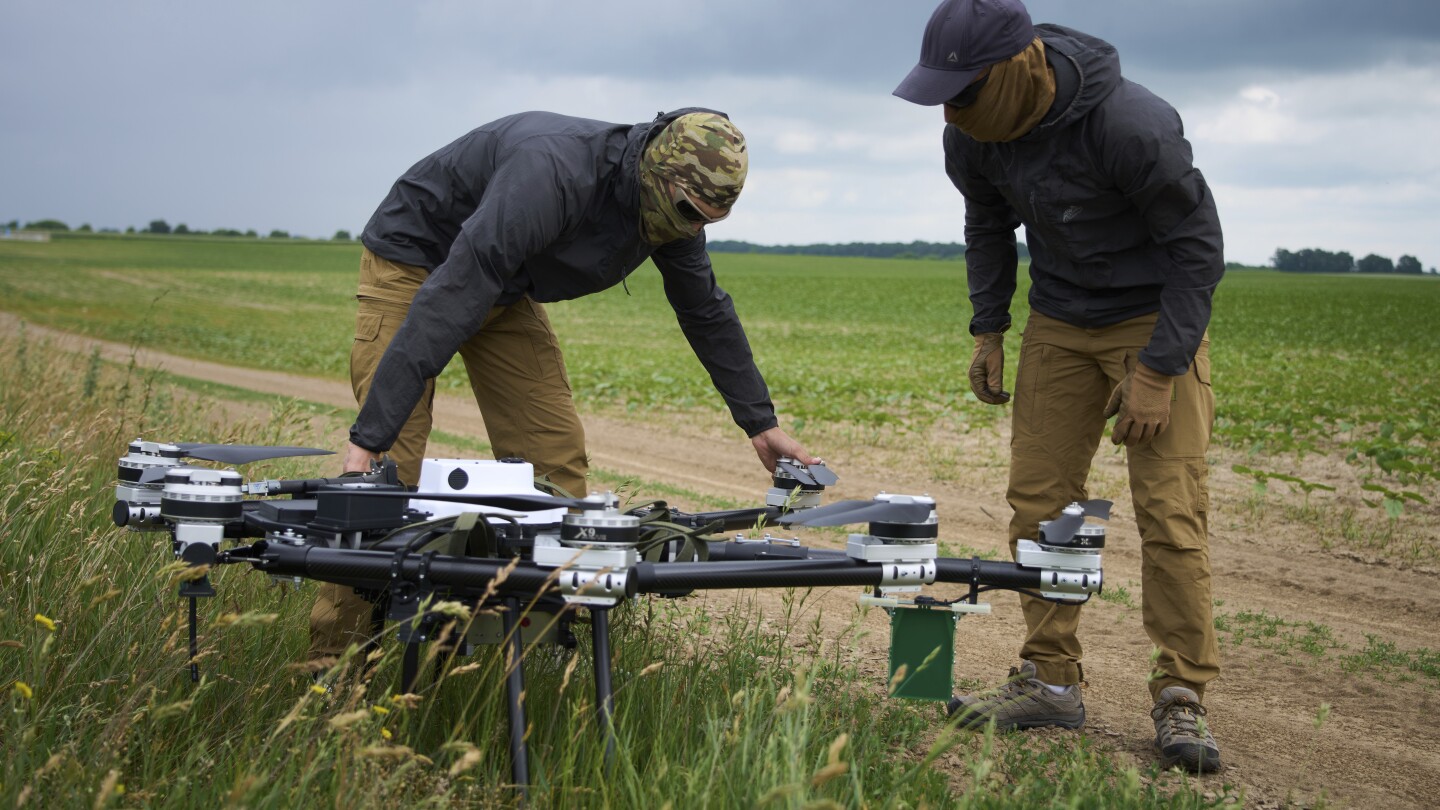
One recent advance in Ukraine’s homegrown arsenal is a quadcopter drone that can evade Russian jamming devices, fly more than 20 kilometers (12 miles) and drop six kilograms (13 pounds) of guided explosives onto tanks and other high-value targets.
“The Ukrainians are the leaders in the world in terms of drone technology,” Keith Kellogg, the Trump administration’s special envoy for Ukraine said last week at a conference in Kyiv. “We are working with Ukrainians now to make sure we have got this drone technology exchange, which I think is very important.”
Europeans have been taking the threat from Russia more seriously since the second Trump administration began signaling that NATO members shouldn’t be overly reliant on the U.S. to defend them. Anxieties across Europe were heightened last week after Russian drones launched from Belarus were shot down in Polish airspace.
For its part, Ukraine is seeking investment to triple its weapons production, become less reliant on Western partners to fight Russia – and hopefully deter future conflicts.
Ukraine’s weapons industry now meets nearly 60% of its army’s needs, up from 10% when Russia’s full-scale invasion began 3 1/2 years ago, according to its defense minister. But its military budget — $64 billion in 2024 — is less than half the size of Russia’s, which is why it turns to Western allies for weapons and, increasingly, money.
In addition to any private investment, and in lieu of NATO membership, security guarantees for Ukraine will likely center on European governments investing in its army — essentially paying Kyiv to build its own weapons and plugging in production gaps with mutually beneficial joint ventures.
European countries are eager to do this, said Fabien Hinz of the International Institute for Strategic Studies in London. “Ukraine has the advantage of having battle-tested systems, of having quite low production costs and having entities in place capable of producing these systems rapidly.”
Launching battle-tested drones
For both sides, the war has necessitated fast cycles of innovation as a matter of survival. How quickly a weapon can be developed, shipped to an army unit and improved upon is a matter of life and death.
Like most defense companies in Ukraine, the maker of the R-34 quadcopter drone — FRDM — communicates with soldiers at all hours of the day and quickly incorporates feedback. Its founder, Vadym Yunyk, is guided by the motto: Robots should die in the front lines, not people.
That underscores one of Ukraine’s disadvantages in this war — its lack of soldiers, which has been a key driver of innovation for Ukrainian defense companies.
Investments in artificial intelligence and robotics are enabling Ukraine to do what its allies could scarcely have imagined before Russia’s full-scale invasion in February 2022. With help from drones and autonomous vehicles, Ukrainian forces can now strike targets with remote-controlled weapons further afield and more precisely, as well as deliver supplies and evacuate the wounded from the front lines without risking other soldiers’ lives.
Ukraine’s small first-person view, or FPV, drones, are responsible for nearly 70% of Russian losses in manpower and weaponry within 15 kilometers of the front line, according to Ukrainian officials.
At the other end of the spectrum are its deep strike drones, which can reach over 1,000 kilometers to hit targets deep inside Russian territory.
FRDM’s quadcopter lies somewhere in the middle. The latest version of the weapon was modified from an earlier model to fly three times farther and carry more guided bombs.
“We learned very quickly how to scale any production. If the government places an order to produce 10,000 drones a year instead of 3,000, I will be capable of doing this in a month and a half,” Yunyk said.
Ukrainian developers boost traditional military wares
Drones aren’t the only area where Ukrainian defense companies are leveraging technology to offset Russia’s much bigger and better-equipped army.
Ukr Armo Tech’s armored personnel carrier, known as the Gurza-1, comes with sophisticated modifications designed to absorb drone strikes and better protect Ukrainian infantrymen, CEO Hennadii Khirhii said.
The Gurza-2, a more agile vehicle that can carry more men, will soon go into production.
Ukr Armo Tech produced 500 vehicles last year for the Ukrainian army, but Khirhii said it has plans to triple capacity.
“Even in the traditional subsector of armored vehicles, we are way ahead of some European companies,” said Pavlo Verkhniatskyi, a defense industry expert based in Kyiv.
“We know the calibers the Russians are using to shoot vehicles, we know the special munitions they use to penetrate armor,” he said. “All this knowledge is put into vehicles produced here.”
Ukraine bets on European investment to deter Russia
European Commission President Ursula von der Leyen has said that, with greater financial support from Europe, Ukraine’s army and defense industry can become a “steel porcupine” that will make the country less vulnerable to attack in the future.
Ukrainian President Volodymyr Zelenskyy says Ukraine is capable of producing at least $30 billion of weapons annually — or roughly three times what currently is budgeted for. It isn’t just money Ukraine is seeking; it also envisions licensing and manufacturing deals with Western arms companies.
Ukraine believes it has expertise to share.
What it has learned from more than three years of war with Russia is that 21st century weapons manufacturers must be able to adapt and deliver to the battlefield more quickly than their predecessors.
“It’s not just about your ability to feed the stocks,” said Arsen Zhumadilov, the head of the state’s procurement agency.
Yunyk said European defense companies have mid- to long-term planning, but they have yet to implement the kind of processes that allow for the type of innovation and rapid turnaround necessitated by modern warfare.
“If you want equipment relevant for today’s war conditions that is the only approach you can take,” he said.
Denmark was the first country to directly finance Ukrainian defense companies, rather than donate weapons. And earlier this month, Zelenskyy said Ukraine was partnering with Danish companies to build components for Ukrainian missiles and drones at a factory in Denmark — out of reach from Russian attacks. Britain has said it has similar plans.
Ukraine is set to receive 1.3 billion euros ($1.5 billion) from a collection of countries, including Denmark, Sweden, Canada, Norway and Iceland, to produce artillery, strike drones, missiles and anti-tank systems. And Germany has made a similar deal, though terms haven’t yet been made public.
Ukraine is also hoping for more joint ventures, said Zhumadilov.
“When they enter the market they invest into the production and then they have their government pay for our ability to buy it and deliver it to the battlefield,” he said. “This is the best.”
