
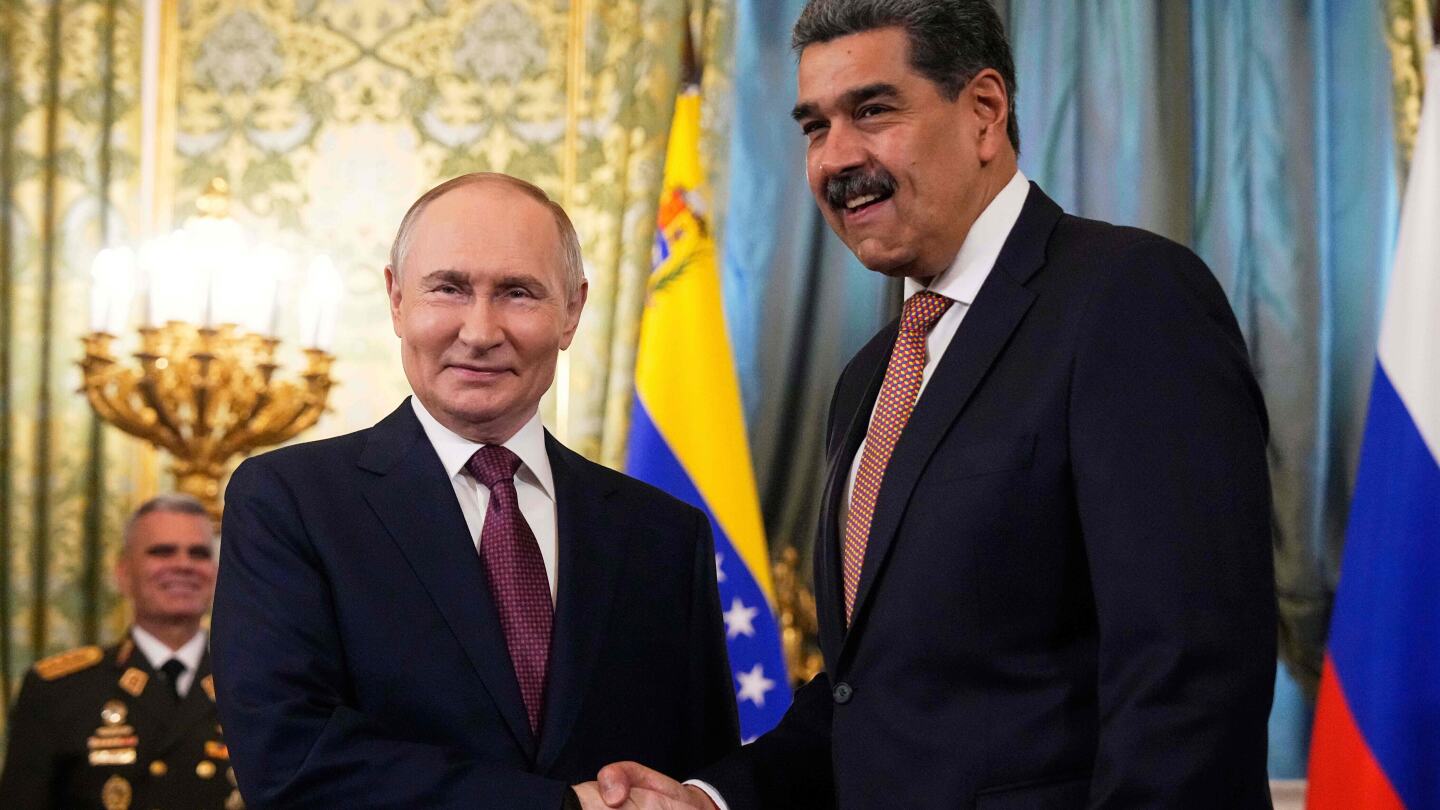
The lightning U.S. operation to capture Venezuelan leader Nicolas Maduro can be seen as both a benefit and a burden for Russian President Vladimir Putin, whose forces botched an attempt to capture Ukraine’s capital and topple its leader at the start of Moscow’s invasion nearly four years ago.
The ouster of Maduro highlights another Kremlin failure to support an ally, following the downfall of Syria’s former President Bashar Assad in 2024 and last year’s U.S. and Israeli attacks on Iran. With the U.S. determined to establish control over Venezuela, Russia stands to lose a strategic foothold in the Western Hemisphere, along with billions of dollars invested in its oil industry.
But President Donald Trump’s actions in Venezuela also are causing unease in Western nations and giving the Kremlin fresh talking points to defend its war in Ukraine.
In addition, Trump’s interest in wresting control of Greenland from NATO ally Denmark also threatens to destabilize the alliance at the moment when the U.S.-led efforts to broker peace in Ukraine enter a pivotal stage, distracting its members from their efforts to support Kyiv and provide it with security guarantees.
Putin himself hasn’t commented on the U.S. actions in Venezuela, which his diplomats have denounced as a blatant act of aggression. Dmitry Medvedev, Russia’s former president who serves as his deputy on the presidential Security Council, similarly rebuked Washington for trampling international law — but also complimented Trump on defending U.S. interests.
“Even though Trump’s action is completely unlawful, he cannot be denied a certain consistency — he and his team are very aggressively upholding their country’s national interests,” Medvedev said.
On Wednesday, the U.S. said it seized two sanctioned oil tankers linked to Venezuela, including one flagged to Russia in the North Atlantic.
Moscow’s ‘spheres of influence’
Since 2014’s illegal annexation of Ukraine’s Crimean Peninsula that followed the ouster of a pro-Kremlin president in Kyiv, Putin has sought to justify his action by describing his neighbor as part of Russia’s sphere of influence where Western encroachment can’t be allowed.
Putin has argued that just as the U.S. would bristle at any foreign military presence in the Western Hemisphere, Russia sees NATO’s expansion to its borders as a major security threat. He cited Ukraine’s bid to join the military alliance as a key reason behind his full-scale invasion of the country.
“We have made it clear and unambiguous that further eastward expansion of NATO is unacceptable,” Putin said shortly before sending troops into Ukraine on Feb. 24, 2022. “Are we the ones placing missiles near the U.S. borders? No, it’s the U.S. that has brought its missiles to our doorstep.”
Long before the invasion, Russia tested the ground on a possible deal under which it would refrain from meddling in Latin America in exchange for the U.S. offering Moscow free rein in Europe.
Fiona Hill, who oversaw Russia and Europe on Trump’s National Security Council during his first term, testified before Congress in 2019 that the Russians were signaling their willingness to make such an arrangement involving Venezuela and Ukraine.
Russia never made a formal offer, Hill told The Associated Press in an interview, but Moscow’s then-ambassador to Washington, Anatoly Antonov, “hinted … many times” to her that Russia could cede its influence in Venezuela to the U.S. in exchange for a sphere of influence in Europe.
She said Trump’s administration wasn’t interested in the Russian overtures that she described as a “hint-hint, nudge-nudge, wink-wink, how-about-doing-a-deal” offer. In April 2019, Hill was sent to Moscow to convey the message that “nobody’s interested. … Ukraine and Venezuela are not related to each other.”
Hill said she did not know if the winds have now changed and whether there was any deal between the U.S. and Russia to swap spheres of influence in Venezuela and Ukraine, but she noted that many officials, including herself, who were involved in “restraining” Trump in his first term aren’t around for his second.
She argued that U.S. Secretary of State Marco Rubio would likely be the only member of the Trump administration who would now resist such a proposal, but added that others, including Trump envoy Steve Witkoff, could have a different view.
“Who knows what Witkoff and others have been chatting about recently?” Hill asked.
Before Maduro was captured, AP reported Russia had started evacuating families of diplomats from Venezuela. When asked about the move, Hill said it would not be “implausible” that Witkoff gave Moscow a “courtesy heads-up.”
Sam Greene, a Russia expert at King’s College London, observed that Moscow may have backed down on Venezuela in the expectation of the U.S. giving it a free hand on Ukraine.
“My worry is that it may be part of a tacit agreement, by which Washington, Moscow and Beijing agree not to deter one another against interventions in their putative spheres of influence,” he wrote on X.
Russia’s foothold in Western Hemisphere
Before the invasion of Ukraine, senior Russian officials had issued vague warnings that Moscow could deploy troops or military assets to Cuba and Venezuela — statements that the U.S. dismissed as bluster. Some drew parallels to the 1962 Cuban Missile Crisis — when the Soviet Union deployed missiles to Cuba and the U.S. imposed a naval blockade of the island.
Russian-Cuban ties withered after the 1991 collapse of the Soviet Union, plunging Cuba into a grueling depression. Soon after his first election in 2000, Putin ordered the closure of a Soviet-built military surveillance facility in Cuba as he sought to improve ties with Washington. As tensions with the U.S. and its allies mounted, however, Moscow again intensified trade and other contacts with Cuba and sent warships to visit the island.
Russia also has invested heavily in Venezuela’s oil industry, as did China, and offered Caracas generous loans to purchase top-of-the-line air defense missiles, fighter jets and other weapons. On several occasions, most recently in 2018, it dispatched its nuclear-capable Tu-160 bombers to Venezuela in a projection of force.
Military experts have said, however, that any attempt by Russia to establish a permanent military foothold in the Western Hemisphere would face overwhelming logistical challenges.
The ‘might-makes-right’ doctrine
The U.S. seizure of Maduro and his wife was seen worldwide as the return of the “might- makes-right” doctrine, backing Moscow’s argument that its action in Ukraine protects its vital interests the way the U.S. did in Venezuela.
After its action in Venezuela, the U.S. has “nothing to formally reproach our country for,” Medvedev noted.
Hill noted that Maduro’s capture makes it harder for countries to condemn Russia’s action in Ukraine because “we’ve just had a situation where the U.S. has taken over — or at least decapitated the government of another country — using fiction.”
An indictment accuses Maduro and others of working with drug cartels to facilitate the shipment of thousands of tons of cocaine into the U.S.
Fyodor Lukyanov, a Kremlin-connected, Moscow-based foreign policy expert, observed that “if we consider what’s happening from the perspective of setting a precedent, then we couldn’t ask for anything better, and this includes Trump’s conviction that the authorities in Venezuela must be approved by Washington.”
Russian hawks, meanwhile, argue the U.S. action in Venezuela has created a new sense of urgency for Moscow to dramatically speed up its offensive in Ukraine.
“Ukraine under our full control is our pass to the Great Powers club,” Alexander Dugin, a hard-line nationalist ideologue, wrote in a commentary.
___
AP European Security Correspondent Emma Burrows in London contributed.
