


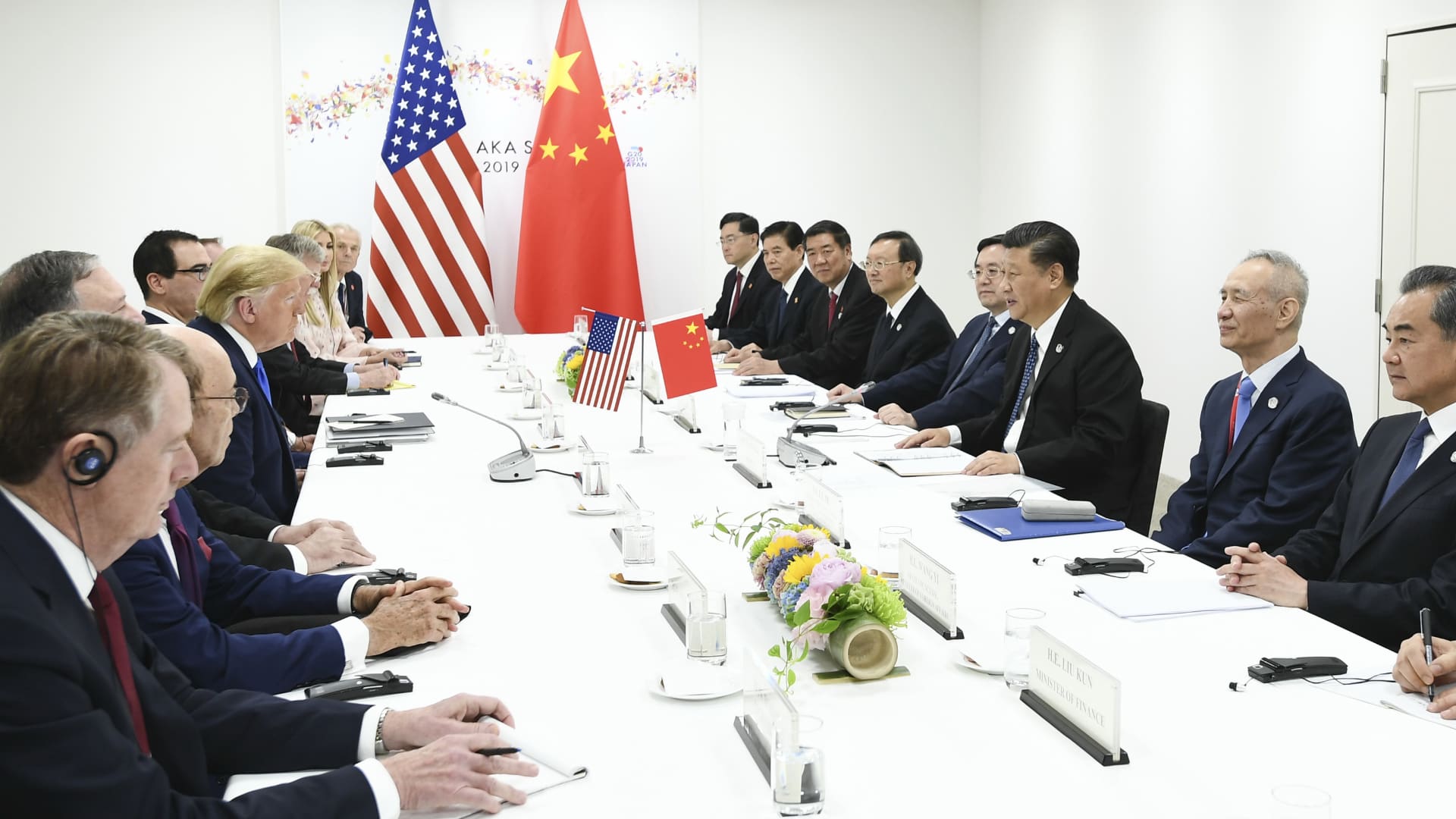
Chinese President Xi Jinping meets with U.S. President Donald Trump in Osaka, Japan, June 29, 2019.
Xinhua News Agency | Xinhua News Agency | Getty Images
The U.S.-China trade truce reached in Geneva was greeted with relief — and in some corners, even celebration. Stock markets surged. Commentators praised the “breakthrough.” But let’s be clear: optimism should be tempered with caution. What we’re witnessing may not be the end of the crisis — rather, it could be the eye of the hurricane. And like all hurricanes, the backside of the storm could be even more punishing than the front.
From Donald Trump’s return to the White House in January through the so-called “Liberation Day” tariff blitz in early April, the world watched U.S. trade policy tear through the global economy. Tariffs on Chinese goods soared to 145% in a matter of weeks, triggering fierce retaliation from Beijing. Now, Washington expects applause for helping contain the damage.
The 90-day truce announced Monday is a moment of calm — a mutually agreed rollback of tariffs to 30%, a temporary lifting of China’s retaliatory curbs on rare earth exports, and a pledge to keep talking. But the underlying structure of the trade relationship remains damaged, fragile, and subject to re-escalation at any moment. Unless serious progress is made before August 10, a 34% “default” tariff — or something closer to 60% or 80% — still looms large.
One of the few refreshing admissions during this episode came from Treasury Secretary Scott Bessent, who conceded that the prior escalation was “the equivalent of an embargo.” His recognition that a mechanism for sustained dialogue should have preceded such drastic actions is welcome — but telling.

That mechanism, now dubbed the “Geneva Mechanism,” is long overdue. Structured engagement between the world’s two largest economies should not be a novel idea. But its success will depend entirely on follow-through — and worryingly, on the moods and machinations of the two men who lead these countries. That alone should give us all great pause.
Nvidia and the ongoing risk from ‘strategic decoupling’
Bessent was also careful to distinguish on the news circuit between “general decoupling” — which he said neither the U.S. nor China desires — and “strategic decoupling,” which remains very much in play.
Sectors like advanced semiconductors, pharmaceutical and medical supplies, steel, and aluminum are deemed too important to rely on China to supply — or too risky to supply to China. That’s why the outlook for companies like Nvidia — even after recent positive news on chip export controls — remains murky. Markets may have glossed over the strategic and national security imperatives during the post-Geneva euphoria, but the intention to de-risk and decouple in key sectors remains deeply embedded in U.S. policy thinking.
Meanwhile, there are clear signals that China is using this window not to deepen or even stabilize reliance on the U.S., but to continue reducing it. State media outlets like Xinhua and Global Times have emphasized the importance of “strategic autonomy” and “dual circulation.” One commentary on Weibo described the truce as a “buffer period for internal strengthening.”
Chinese policymakers are not wasting this pause — they are hardening their own supply chains and innovation ecosystems. U.S. companies should read that signal clearly and respond in kind.
Among the issues under discussion through the Geneva Mechanism are non-tariff barriers — a quiet but potent set of tools China has used for years. These include opaque licensing procedures, indigenous IP requirements, unfair procurement preferences, data localization mandates, and increasingly burdensome compliance expectations for foreign firms. Addressing these barriers in 90 days is ambitious at best, and likely unrealistic.
Then there’s fentanyl. The inclusion of China’s Minister of Public Security in the Geneva talks was meant to signal seriousness. But this is not the first time China has pledged cooperation. In 2019, Beijing banned all fentanyl-class substances, only to quietly ease enforcement when political winds shifted. At the 2023 APEC summit in San Francisco, China again promised action on fentanyl precursors during leader-level talks with President Biden. Those promises, too, were welcomed — then quietly shelved. The U.S. has bought this horse several times before — it just keeps getting re-gifted. Without enforceable mechanisms and measurable benchmarks, any new commitments risk being more performance than policy.
The truth about opening China’s market to U.S. companies
Another narrative that needs correcting is this: the idea that opening China’s market to U.S. firms is still the great win it once was. That might have been true in 2001, when China joined the WTO, or even as recently as 2018 at the start of the first trade war. But it misses today’s reality. China’s domestic markets are now highly developed, hyper-competitive, and increasingly nationalistic.
U.S. firms not only face fierce competition from Chinese counterparts that are often cheaper, faster, and better — they also operate in an environment where being a foreign brand is becoming a reputational headwind. In an era where Trump’s rhetoric has inadvertently fueled nationalist fervor abroad, American companies in China face shrinking commercial advantage and rising political risk. Expanding into China today is not the win it once might have been — it may be an invitation to future retaliation and regulatory entanglements.
This is why companies should treat this truce not as a reprieve but as a window — a precious opportunity — to act. The years since the first trade war in 2018, the Covid shock, and ongoing geopolitical tension should have been more than enough warning. Yet too many firms remain overexposed to China, lulled by temporary market access or short-term pricing advantages. That complacency is dangerous. Surely, that is not a far-fetched assertion given all that has happened since 2018.
Over the next 90 days, businesses should be doing two things. First, fortify their short-term plans and supply lines against the potential for renewed volatility at the end of the 90-day pause. Second — and more importantly — accelerate long-term diversification strategies. Whether it’s Southeast Asia, Latin America, or reshoring to the U.S., this is the time to move. Structural dependence on China is no longer a business challenge — it’s a strategic liability.
The calm may feel good, but it is not the end. This is the eye of the storm. The back half could come fast — and hit hard.
—By Dewardric McNeal, Managing Director and Senior Policy Analyst at Longview Global
